The Hofburg in Vienna Explained, Six Centuries of Habsburg Building in One Palace
The Hofburg isn't a palace in the way Schönbrunn or Versailles is. Nobody designed it. It grew, wing by wing, for more than six hundred years, each ruler adding what he or she needed in the style of the day, and nobody ever went back to make it match. Walk from Michaelerplatz to Heldenplatz and you pass through Gothic, Renaissance, Baroque, Rococo and the last pomp of the 1900s in about ten minutes.
The numbers are a city's, not a house's. The palace covers about 240,000 square metres, with 19 courtyards and some 2,600 rooms. Around 5,000 people work or live in it today. It belongs to the Republic of Austria and is run by a federal agency, the Burghauptmannschaft.
It was the Habsburgs' main residence from the late 13th century until 1918. Since then it has been a government building, a museum quarter and an office block, often all on the same staircase.

From castle to palace
The core is a square castle with four corner towers built in the 13th century around what is now the Schweizerhof, the Swiss Court. The sources argue about who started it, the last Babenberg dukes or King Ottokar II of Bohemia, who held Austria in the 1270s. What's certain is that Rudolf I of Habsburg beat Ottokar in 1278 and that the castle is documented as a Habsburg seat from 1279. The Gothic court chapel was there by the 15th century, and the red and black Swiss Gate went in in 1552. You can still see the old castle's shape in the courtyard.
The family then built outward:
- Stallburg, from 1559, a Renaissance palace for the future Maximilian II that became the court stables. The Lipizzaners still live there.
- Amalienburg, begun 1575 for Rudolf II's household, finished 1611. Its tower carries a sundial and a clock that shows the phases of the moon.
- Leopoldine Wing, 1660s, joining the old castle to the Amalienburg. It burned in 1668 before it was finished and was rebuilt. Maria Theresa lived here. The Federal President works here now.
- Imperial Chancellery Wing, 1723 to 1730, by Lukas von Hildebrandt and then Joseph Emanuel Fischer von Erlach, closing the courtyard called In der Burg on the north side.
- Court Library and Winter Riding School, 1720s and 1730s, both on the Fischer von Erlach father-and-son designs. The library hall is the State Hall of the National Library today.
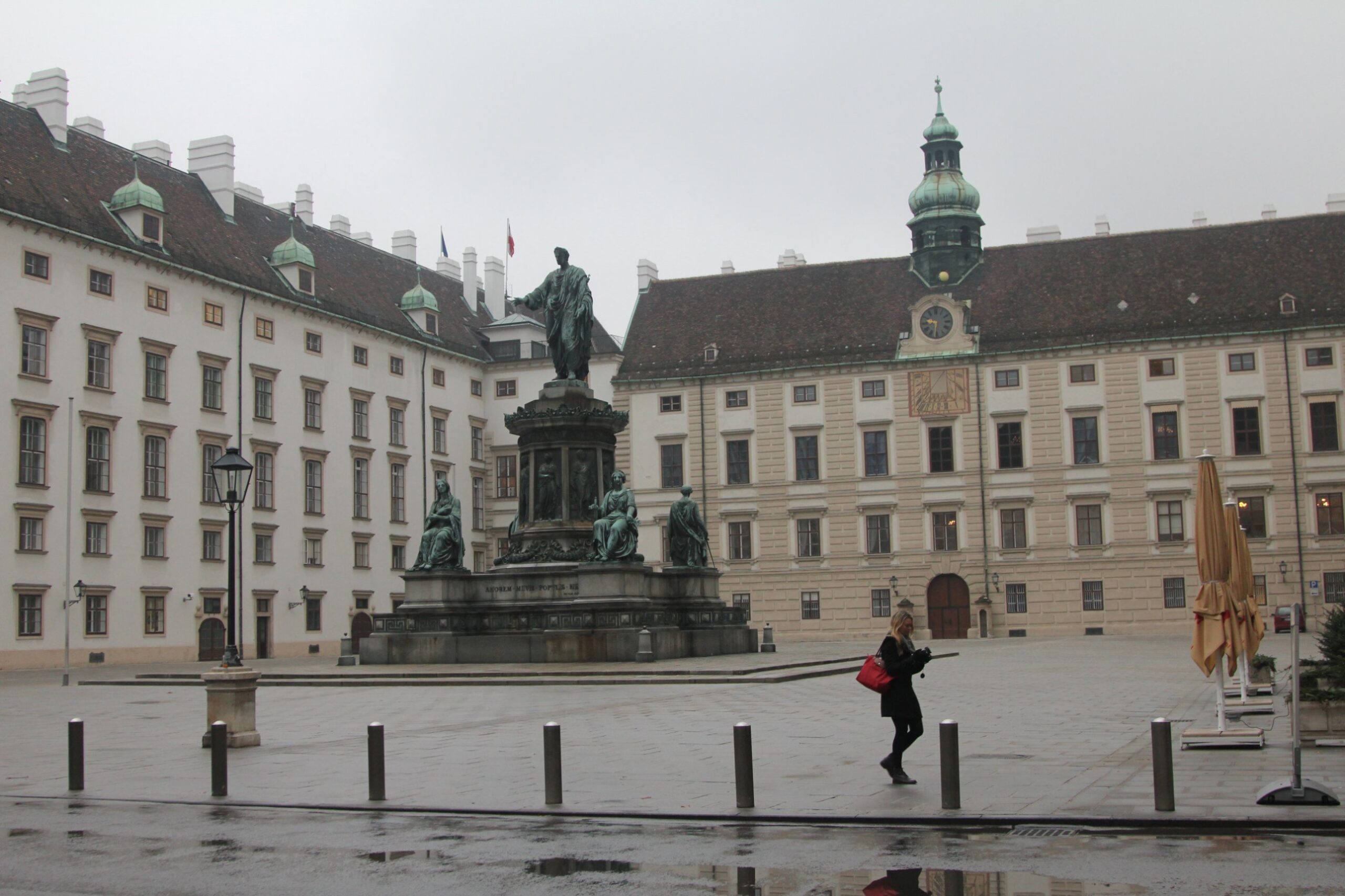
Photo: Virtual Travel Guide
The two late additions
The Michaelertrakt, the curved front with the big green dome facing Michaelerplatz, looks Baroque and is mostly from the 1890s. Joseph Emanuel Fischer von Erlach designed it in 1726, but the old court theatre stood in the way. Only when the Burgtheater moved to the Ring did Ferdinand Kirschner finish the wing, between 1889 and 1893. The two big fountains on its façade stand for Austria's power at sea and on land.
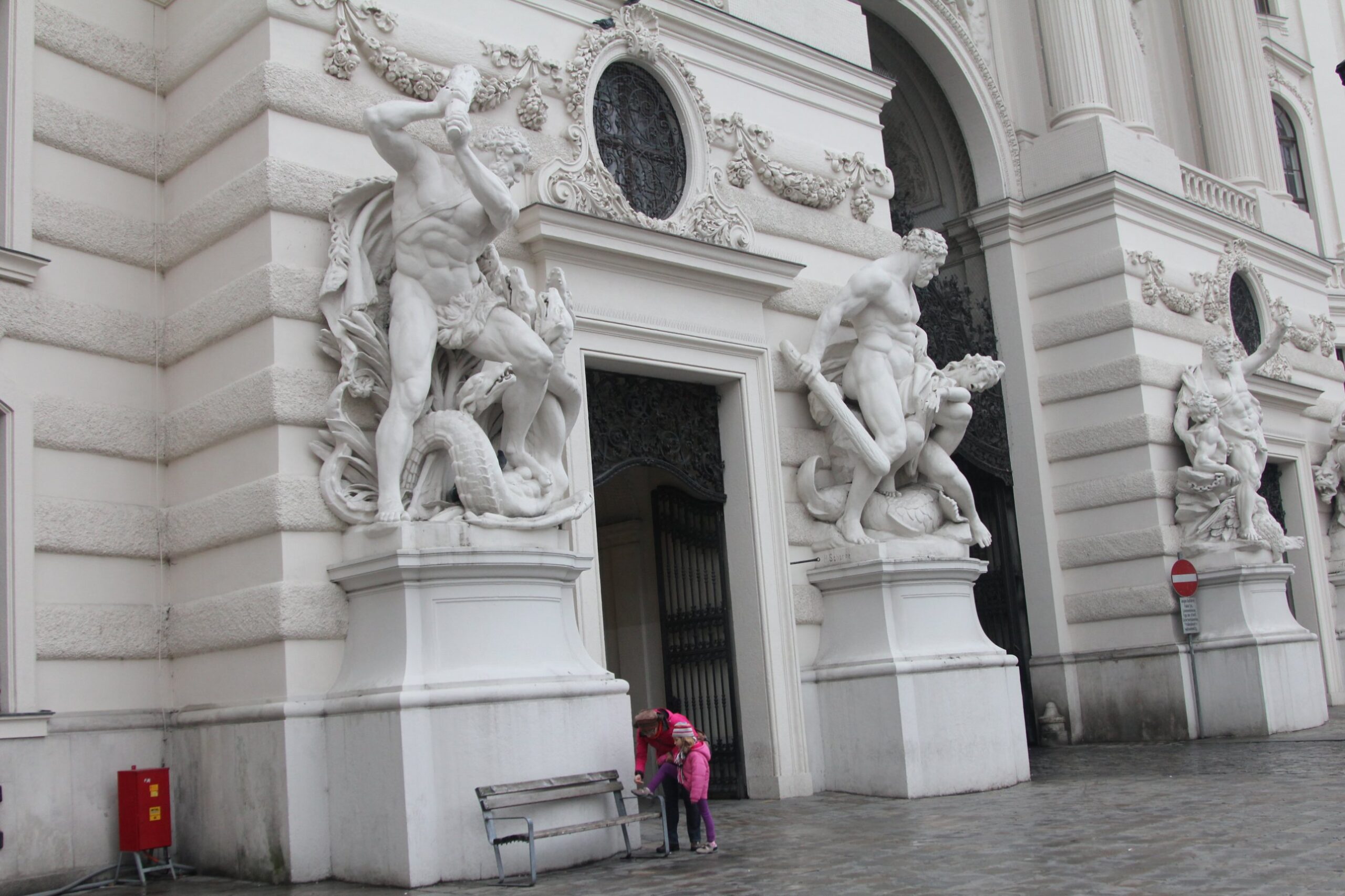
Photo: Virtual Travel Guide
The Neue Burg on Heldenplatz is the last and largest piece, built from 1881 as one half of Gottfried Semper's Kaiserforum, a vast imperial square that was meant to reach across the Ring to the two museums. The empire ran out before the plan did. The Neue Burg was structurally finished by 1913 and its interiors in the 1920s, and the second matching wing was never built.
What's in it now
Most of the palace is offices. The parts you can visit are run by different institutions, each with its own ticket:
- the Imperial Apartments, Sisi Museum and Silver Collection, under the Michaelertrakt dome
- the Imperial Treasury, in the Schweizerhof
- the Spanish Riding School, on Michaelerplatz
- the State Hall of the Austrian National Library, on Josefsplatz
- the Albertina, on the old city wall at the southern end
- the Weltmuseum, the Imperial Armoury, the musical instruments collection and the Ephesos Museum, in the Neue Burg
Also inside: the Federal President's office, the OSCE, the Austrian National Library's reading rooms, and the Burgkapelle, where the Vienna Boys' Choir sings Sunday Mass.
On Michaelerplatz, in the middle of the square in front of the dome, a sunken enclosure shows the foundations of Roman houses from the civilian settlement outside the Vindobona legionary fort, used from about the end of the 1st century into the 5th. They're the oldest thing in the palace's orbit, and they're free.