Heldenplatz in Vienna, the Unfinished Imperial Square and Its Heaviest Day in March 1938
Heldenplatz is the big open square on the Ring side of the Hofburg: lawns, two bronze horsemen, the curved front of the Neue Burg, and a long view across to the Burgtheater and City Hall. It looks finished. It isn't. It's half of a plan the empire never completed, on ground Napoleon cleared.
Before 1809 this was the city wall. When French troops left Vienna that year they blew up the Burgbastei, the bastion in front of the palace. From 1817 the rubble was levelled, and the space became a parade ground and a pair of gardens, the Volksgarten to the north and the Burggarten to the south. The name Heldenplatz, Heroes' Square, came into use later in the 19th century. Nobody seems to have made it official until much later.
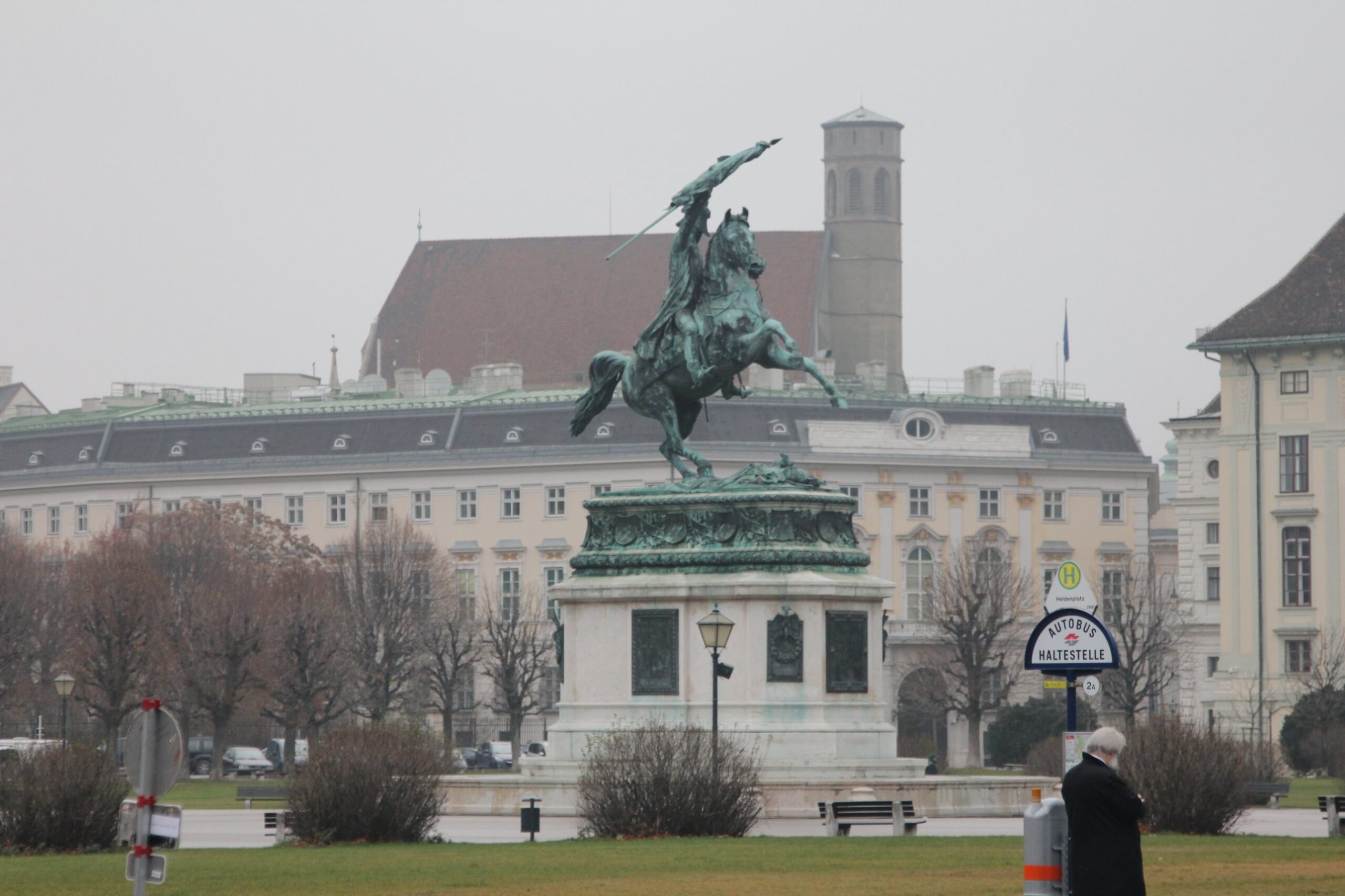
Photo: Virtual Travel Guide
The two heroes
The horsemen were made by the same sculptor, Anton Dominik Fernkorn.
Archduke Charles, unveiled in 1860, honours the general who beat Napoleon at Aspern in 1809. The horse rears up on its hind legs, a hard thing to cast in bronze and balance, and the reason people still stop to look at it.
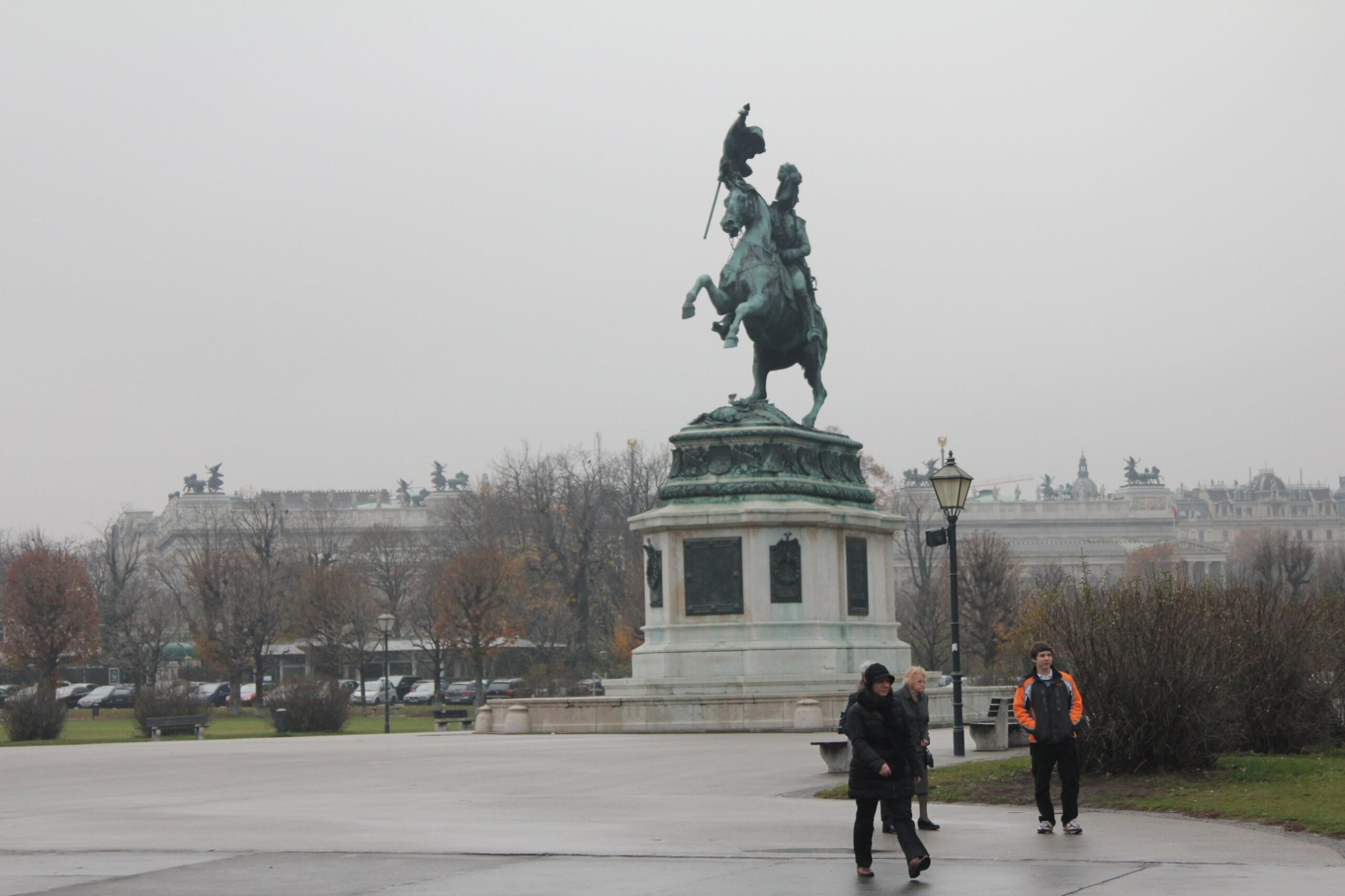
Photo: Virtual Travel Guide
Prince Eugene of Savoy, unveiled in 1865, faces him across the square. Eugene led the campaigns that pushed the Ottomans out of Hungary after the siege of Vienna in 1683. Fernkorn had a stroke while working on it, and his pupils finished the job.
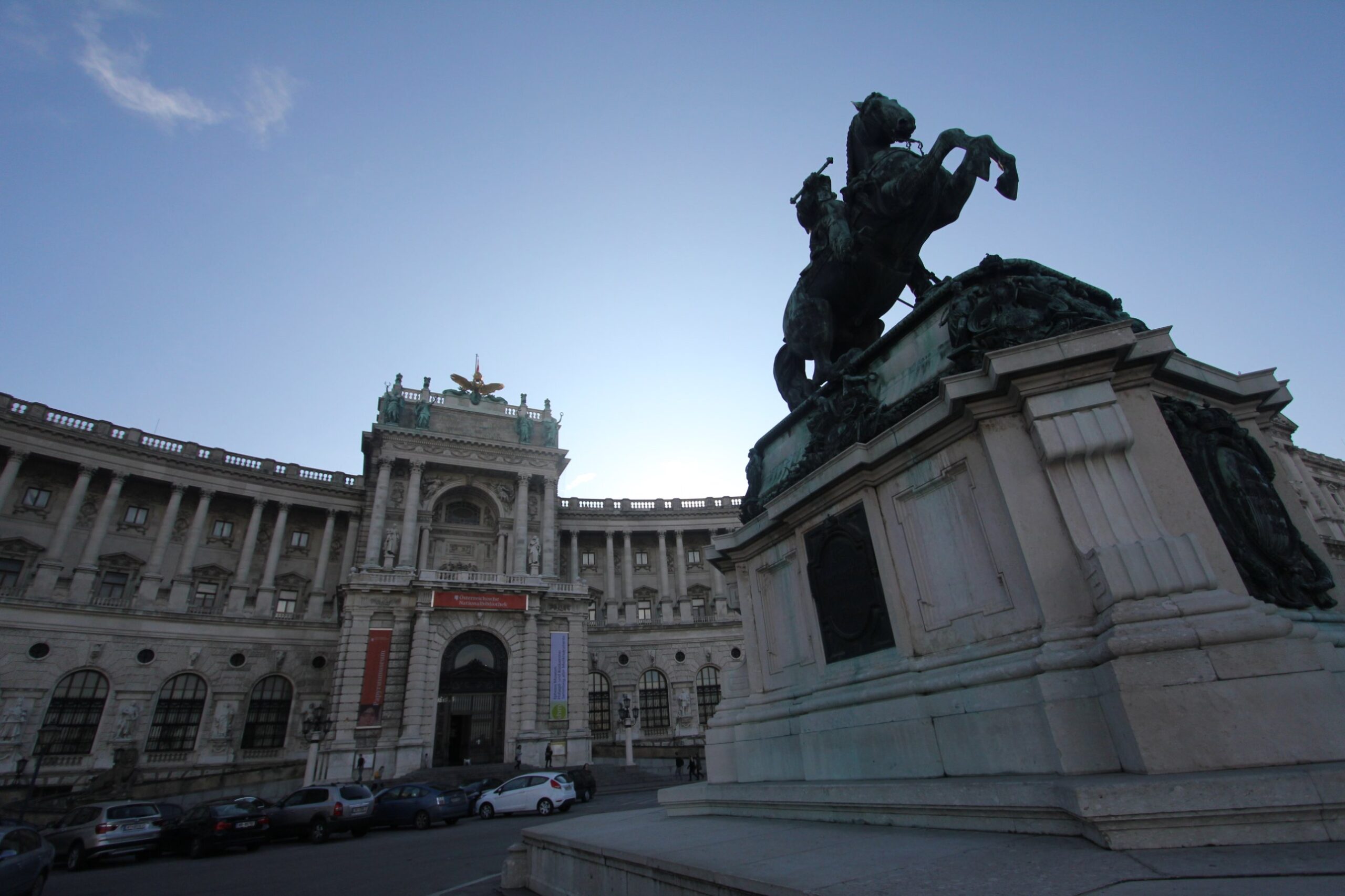
Photo: Virtual Travel Guide
An empire's last plan
In the late 1860s Franz Joseph commissioned Gottfried Semper and Carl von Hasenauer to design a Kaiserforum, an imperial forum that would join the Hofburg to the two great new museums across the Ring. Two matching curved wings would frame Heldenplatz.
The museums got built, the Natural History Museum and the Kunsthistorisches Museum, opened in 1889 and 1891. The Neue Burg, the south-east wing, went up from 1881 and was structurally done by 1913. The north-west wing, which would have stood where the Volksgarten opens onto the square, was never started. That's why Heldenplatz has one curved side and one open side.
The Äußeres Burgtor, the gate on the Ring, is older than all of this. It was built between 1821 and 1824 to honour the soldiers of the Napoleonic Wars, and was turned into Austria's heroes' memorial in 1933 and 1934, with a crypt for the war dead.
15 March 1938
The square's most photographed moment is the one Austria least wants to remember. On 15 March 1938, three days after German troops crossed the border, Hitler stood on the balcony of the Neue Burg and announced Austria's "entry into the German Reich" to a packed square. Nazi propaganda put the crowd at about 200,000. The newsreels were made to be seen around the world.
Austria took decades to talk about that day honestly. Thomas Bernhard named his last play, in 1988, after the square.
Today the same space is used to make the opposite point. Since 2013 the Mauthausen Committee has held a concert on Heldenplatz on 8 May, the day the war in Europe ended, called the Fest der Freude, the Festival of Joy. In 2026 it was the fourteenth, with the Vienna Symphony Orchestra and the Federal President among the speakers.
The square through the year
Around 26 October, Austria's National Day, the armed forces take over Heldenplatz with a display of vehicles, equipment and units, ending with new recruits being sworn in on the day itself. For 2026 the programme runs from 20 to 26 October.
The rest of the year it's lawns and paths, and the way most visitors walk from the Ring into the palace. Stand by the Archduke Charles statue and look at the Neue Burg. That's the Hofburg at its grandest, and it's also exactly where the plan stopped.
For the rooms behind that façade, see what's in the Neue Burg and our guide to the whole palace.