Golden Fleece Herald Chain of Arms in Vienna, the Collar That Showed Every Knight of the Order
Most of the Order of the Golden Fleece's treasure is about the knights. This piece belonged to the man who kept track of them. It's the potence, the chain of arms worn by the Order's chief herald, and it was built so that he carried the coat of arms of every living knight around his shoulders.
It was made in the Southern Netherlands around 1517, in gold and enamel. The maker isn't known. It is displayed in the Imperial Treasury in Vienna, in the rooms of the Burgundian inheritance and the Order of the Golden Fleece.
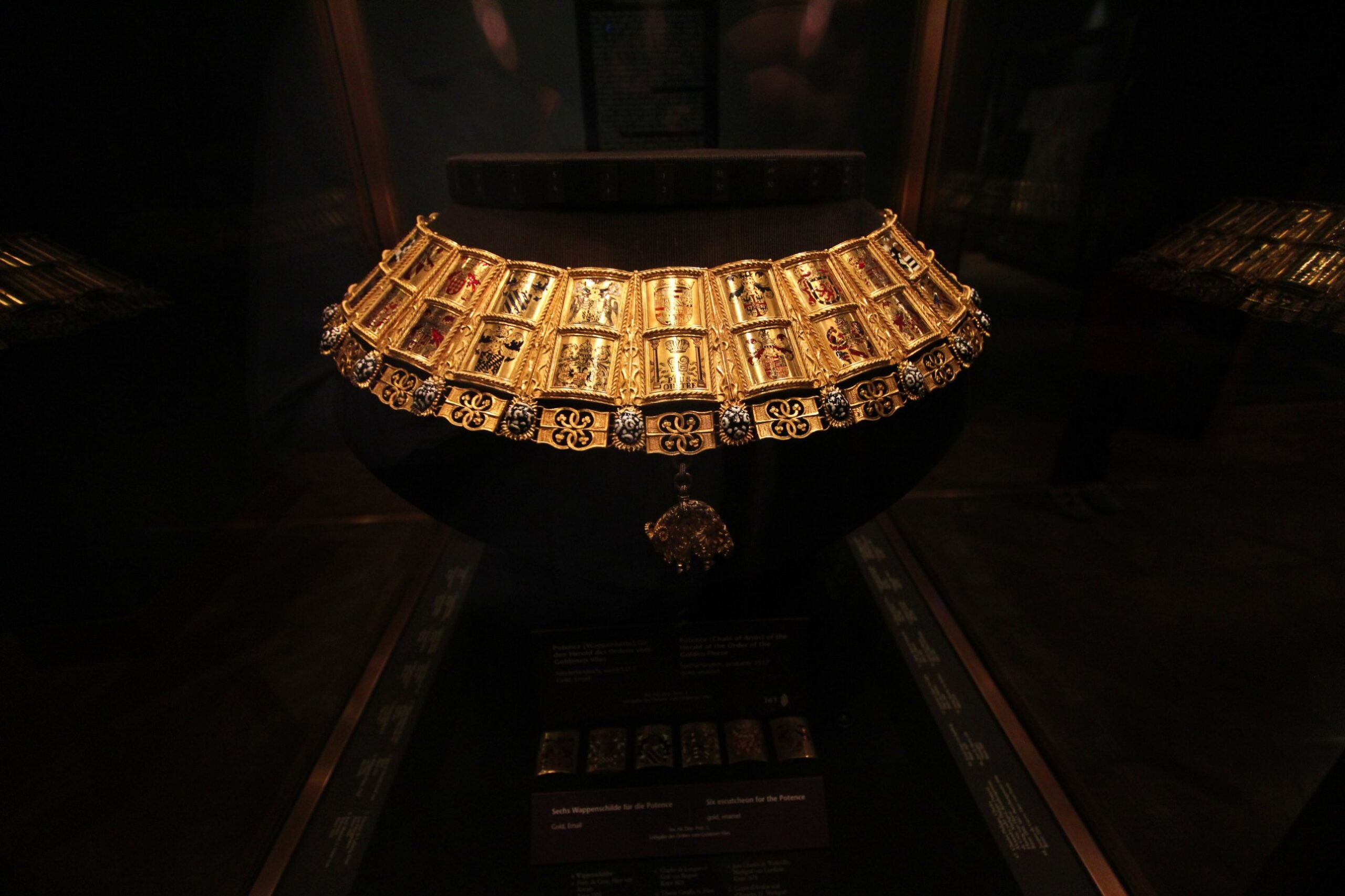
Photo: Virtual Travel Guide
How it works
The potence is two things joined together: a knight's neck chain of the Order, and a broad collar of gold plates. The museum describes 26 pairs of convex, slightly tapering plates set in two rows. Each plate has a window, and behind the windows slide small enamelled shields with coats of arms. When a knight died and another was elected, the herald could change the shields.
The count wasn't arbitrary. At the chapter of 1516 the Order's sovereign, the future Emperor Charles V, raised the number of knights to 51, himself included. The collar has room for all of them, with two places kept for the sovereign. Those carry Charles's own emblem: the Pillars of Hercules, standing for the rocks of Gibraltar and Ceuta, and his motto PLUS OULTRE, further still.
The museum adds, a little drily, that the rule of keeping every knight's arms up to date "was not always observed."
The potence replaced an older chain of 16 links made when the Order had 31 members. The outer edge measures 143 centimetres around and the collar is about 10 centimetres wide.
The herald and his order
The man who wore it was the king of arms of the Order, known by the title Toison d'or, Golden Fleece. He was one of the Order's four officers, with the chancellor, the treasurer and the registrar. The office goes back to 1431, and it outranked every other herald in Burgundy and the Netherlands. He wore the potence on the Order's great occasions.
Philip the Good, Duke of Burgundy, founded the Order in Bruges on 10 January 1430, on his marriage to Isabella of Portugal. When the last duke, Charles the Bold, was killed in 1477, his daughter Mary of Burgundy married Maximilian I, and the Order passed to the Habsburgs with her lands. After the Spanish Habsburgs died out in 1700 it split into a Spanish branch and an Austrian branch. Both still exist.
From Brussels to the Schweizerhof
The Order's treasure and archive stayed in the Low Countries for centuries. In the 1790s, with French armies advancing, they were brought from Brussels to Vienna, and they have been in the Treasury since.
They belong to the Order, not the Austrian state. Austria confirmed the Order's legal standing, and its ownership of treasure and archive, after the Second World War.
Around the potence in the same rooms are the Order's oldest treasures: the oath cross the knights still swear on, made in France around 1400 and once owned by Jean de Berry; Mass vestments of the Order's chapel from the 1420s to 1440s; and the only neck chain to survive from the Order's early years, with its flints and fire-steels and the motto "Ante ferit quam flamma micet", it strikes before the flame leaps up.
For the rest of the Treasury, prices and opening days, see our Treasury guide. For the crown that sits a few rooms away, see the Imperial Crown of Austria.