Two Jewelled Flower Bouquets in the Imperial Treasury, Gold and Gemstone Flowers From the Late 17th Century
Among the crowns and regalia of the Imperial Treasury stand two small vases of flowers that will never wilt. Every petal is gold, enamel or a cut stone: diamonds, emeralds, rubies, sapphires and hyacinth, gathered into two matching bouquets about a quarter of a metre high.
They are easy to walk past next to the big pieces. They reward a slow look.
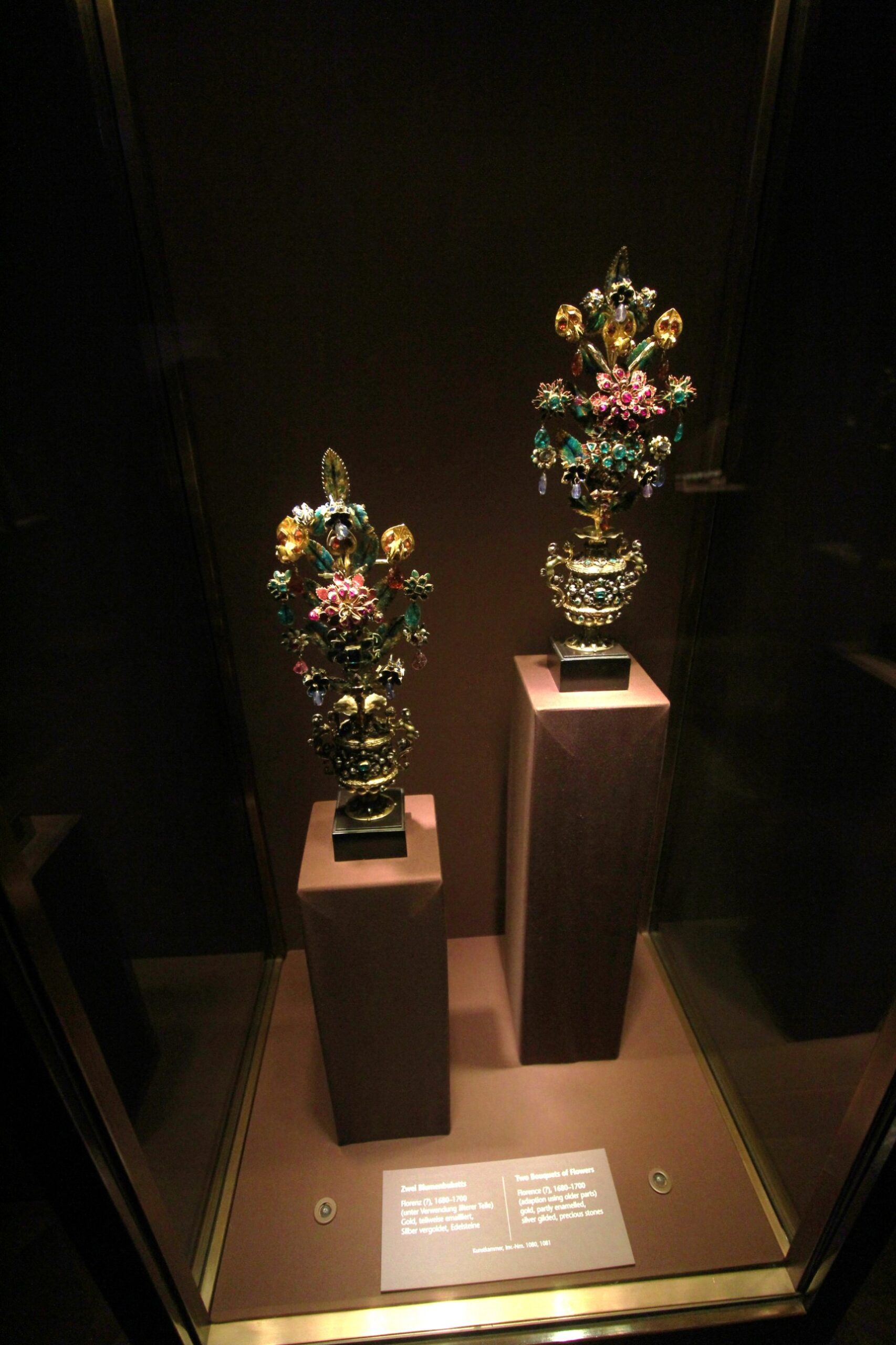
Photo: Virtual Travel Guide
What they are
The museum catalogues them as a pair, inventory numbers 1080 and 1081, each 25.2 centimetres high. They are made of gold, partly enamelled, and silver gilt, set with diamonds, emeralds, rubies, sapphires and hyacinth, a reddish-orange zircon.
The date is given as the late 17th century, using older parts. That last phrase matters: some of the flowers and settings were reused from earlier jewellery, which was common practice. Precious stones were capital, and jewellers took apart old pieces to make new ones in the current taste.
The place is less certain. The museum says Florence, or Vienna. Florence had the grand ducal workshops of the Medici, famous for this kind of hardstone and jewelled work, and the Habsburgs and Medici exchanged gifts and married into each other's families. But Vienna had skilled court jewellers too, and the museum leaves it open.
A history nobody wrote down
What the museum doesn't give is a provenance. There's no recorded owner, no gift, no occasion. They belong to the Kunstkammer of the Kunsthistorisches Museum, the old imperial cabinet of art and curiosities, and are lent to the Treasury for display.
That is a slightly unusual thing to admit in a room where most objects come with a coronation, a wedding or a named emperor attached. It also leaves you free to look at them as what they are: virtuoso goldsmith's work, a still life in metal and stone.
Maria Theresa's bigger bouquet
If you like these, there's a larger and better-known cousin across the Ring. In the Natural History Museum is the gemstone bouquet associated with Maria Theresa, made by the Viennese jeweller Michael Grosser around 1760. It is about half a metre high, weighs around 2.8 kilos and carries 2,102 diamonds and 761 coloured stones. The museum has it on special display in a pop-up showcase from April 2026 into early 2027.
Seeing them
The two bouquets are in the Secular Treasury in the Schweizerhof, the oldest part of the palace, behind the Swiss Gate. For tickets and the rest of the rooms, see our Treasury guide, and for another piece of virtuoso stonework nearby, the great emerald vessel.