Maximilian of Mexico in the Imperial Treasury, the Sceptres and Cane of the Habsburg Emperor Shot in Queretaro
Most of the Imperial Treasury is about power that lasted centuries. One case is about an empire that lasted three years. It holds the chains of two Mexican orders, three sceptres and a tortoiseshell walking cane, all that the Treasury keeps of Maximilian, Emperor of Mexico, Franz Joseph's younger brother, who was shot by a firing squad in 1867.
The label calls them pieces commemorating Emperor Maximilian of Mexico. They have been on show since the Treasury reopened in 1928.
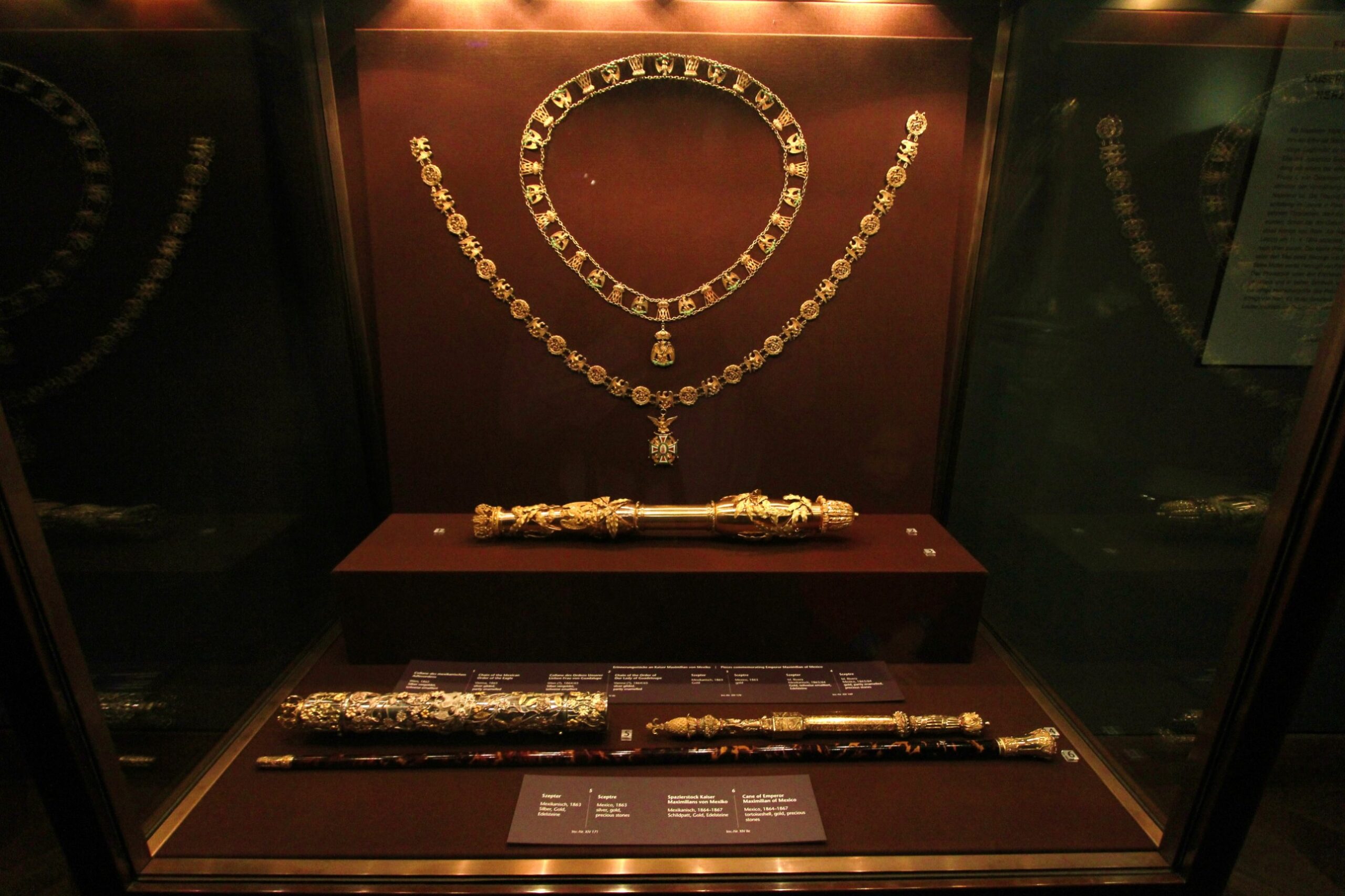
Photo: Virtual Travel Guide
The archduke who took a crown
Maximilian was born at Schönbrunn in 1832. He commanded the Austrian navy from 1854, built the white castle of Miramare on the sea near Trieste, and in 1857 married Charlotte of Belgium.
In 1863 Mexican conservatives, backed by Napoleon III's army, offered him the crown of a new Mexican empire. He accepted at Miramare on 10 April 1864, sailed on the frigate Novara and landed at Veracruz on 29 May. The empire never had the country behind it. When the French troops left, the republican forces of Benito Juárez closed in. Maximilian was captured, tried and shot on the Cerro de las Campanas at Querétaro on 19 June 1867, with his generals Miramón and Mejía.
His body came home on the Novara and was laid in the Imperial Crypt in Vienna on 18 January 1868. Charlotte, who had gone to Europe in 1866 to beg for help, broke down and lived out her life in seclusion in Belgium. She died in 1927.
What's in the case
The museum labels give the objects plainly.
Two order chains. The chain of the Mexican Order of the Eagle, made in Vienna, around 1865, silver gilt and partly enamelled. Maximilian founded that order on 1 January 1865 to reward civil and military service, science and art, and to win recognition from the courts of Europe. Beside it hangs the chain of the Order of Our Lady of Guadalupe, probably Vienna, 1864 or 1865, also silver gilt and enamelled. That order was older: founded under Mexico's first emperor, Agustín de Iturbide, in the early 1820s, revived more than once, and given new imperial statutes by Maximilian in April 1865.
Three sceptres. One, Mexican, from 1863, in gold. One, Mexican, from 1863, in silver, gold and precious stones. The third, signed by the goldsmith M. Rivera, from 1863 or 1864, is gold, partly enamelled and set with precious stones. All three were made in Mexico in the months when the new empire was being prepared and proclaimed.
The cane. "Cane of Emperor Maximilian of Mexico", says the label: Mexican, 1864 to 1867, tortoiseshell, gold and precious stones.
Why it's here
These aren't crown jewels in the sense of the Imperial Crown of Austria a few rooms away. They're keepsakes of a brother. Franz Joseph had let Maximilian go, made him give up his Austrian rights first, and then could do nothing to save him. The objects came back to the family, and the family kept them.
The case is in the Secular Treasury. For prices and opening days, see our Treasury guide.