Emerald Vessel in the Imperial Treasury Vienna, Carved From One Colombian Crystal by Dionysio Miseroni in 1641
It's the size of a large fist, 10.9 centimetres tall. In the Treasury's jewels room it sits alone in a dark case, lit from above, and it glows. It is one emerald, hollowed out into a small pot with a lid, and the Imperial Treasury counts it among the largest emeralds in the world.
The museum calls it the emerald unguentarium, a vessel for ointment. Nobody ever kept ointment in it. It was made to be looked at, and to show what the emperor could afford.
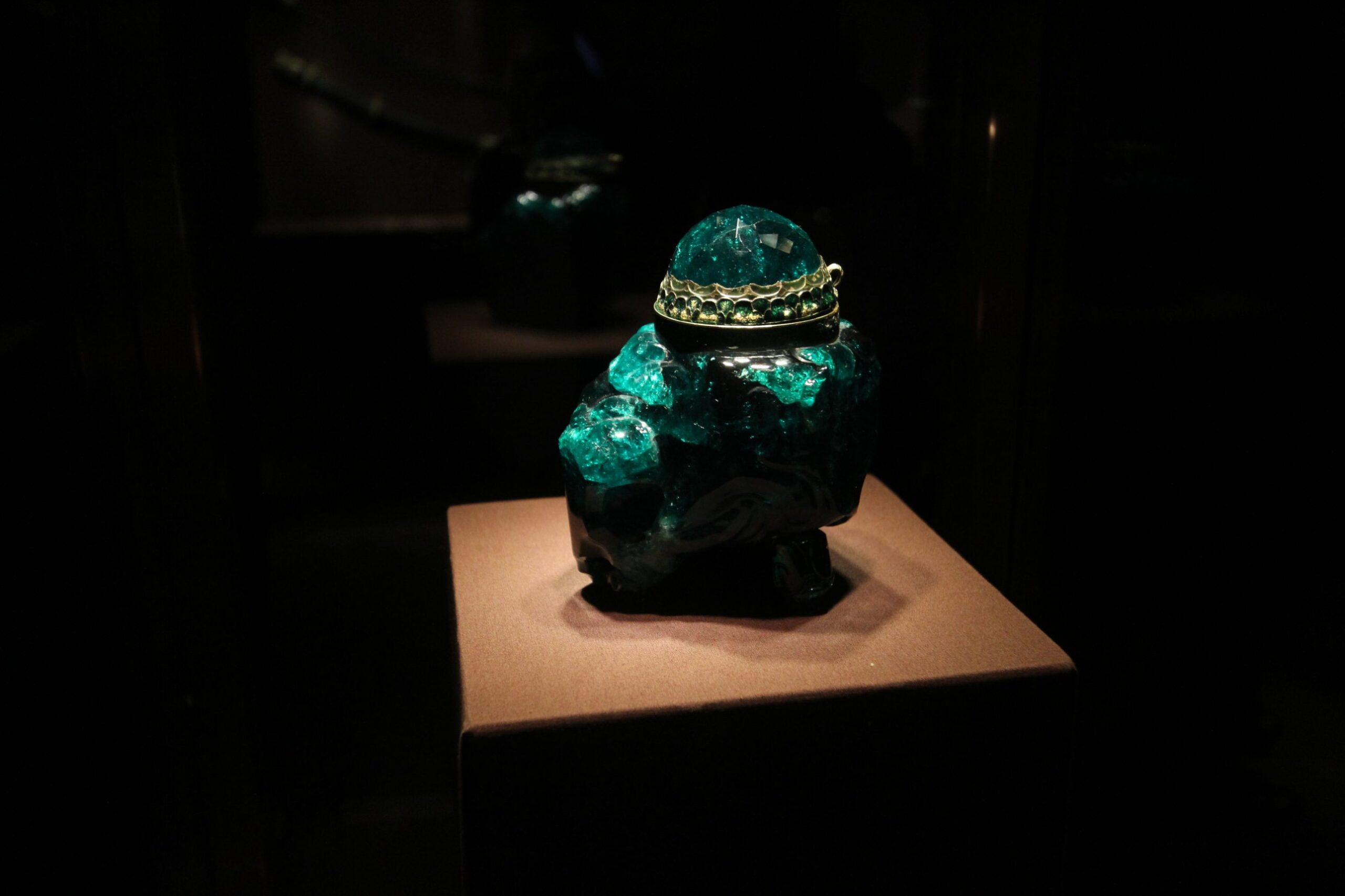
Photo: Virtual Travel Guide
A stone from Muzo
The emerald came from the Muzo mine in Colombia, which the Spanish found in 1558. The rough stone is two crystals that grew together. It was probably bought by Rudolf II, the collector-emperor in Prague, and it first appears in the records in the inventory of his brother Matthias's estate in 1619.
Gem references put the finished vessel at about 2,860 carats, a little over half a kilo. The museum doesn't publish a weight.
Cut in Prague
Emperor Ferdinand III gave the stone to Dionysio Miseroni, the leading hardstone cutter at the imperial court. The Miseroni were a family of gem cutters from Milan. Dionysio's father Ottavio had opened a workshop in Prague in 1588 to work for Rudolf II's court, and Dionysio took it over, along with the post of imperial treasure warden at Prague Castle.
He let the crystal decide the shape. That's why the outline is irregular, and why so much of the stone was lost: the cutting followed the natural form, and then four leaves were carved hanging from the shoulder and an acanthus leaf at the base. The lid was cut from the emerald he removed from the inside. Its underside is gold, engraved with flowers under translucent green enamel. The rim stayed uneven, so a goldsmith added a ring of green-enamelled gold to give the lid a level seat.
The work was finished in 1641. The museum's own catalogue note is blunt about it: "Today one must regret the reduction in this emerald's unique size."
Twelve thousand guilders
Ferdinand III paid Miseroni 12,000 guilders, in instalments. Miseroni kept the leftover fragments, and jewellers offered him gold or stones worth 2,500 guilders for them.
The vessel went straight into the imperial treasury and became one of the things visitors were taken to see. In the 17th century they were told that the Muscovites had offered several chests of pearls for it, and that the Grand Duke of Florence would have traded three tonnes of gold. Those are court stories, not documented offers. They tell you how the Habsburgs wanted it talked about.
Formally it still belongs to the Kunstkammer collection of the Kunsthistorisches Museum, which lends it to the Treasury.
The family in the painting
In 1653 the Prague painter Karel Škréta painted Dionysio Miseroni with his family. It hangs in the National Gallery in Prague. Dionysio wears a gold medal from Ferdinand III, and behind the family you can see the water-powered cutting machinery of the workshop. A vessel in the background is sometimes identified as this emerald.
The emerald is in the Secular Treasury, among the jewels. The Treasury is open Wednesday to Monday, with timed tickets, and closed on Tuesdays. Our Treasury guide has prices and the rest of the rooms.