Swiss Gate of the Hofburg, the Renaissance Portal Ferdinand I Built in 1552
Walk into the courtyard In der Burg and turn towards the oldest part of the palace, and you're looking at the most photographed doorway in the Hofburg. The Swiss Gate is red and black and gold, set into a plain white wall, with a long Latin inscription over the arch and the Habsburg arms in the middle. It leads into the Schweizerhof, the medieval core of the palace, and to the Treasury and the court chapel behind it.
It was built in 1552 and 1553 for Ferdinand I, brother of Charles V, and it's one of the first Renaissance pieces in a palace that was still, at the time, a fortified castle.
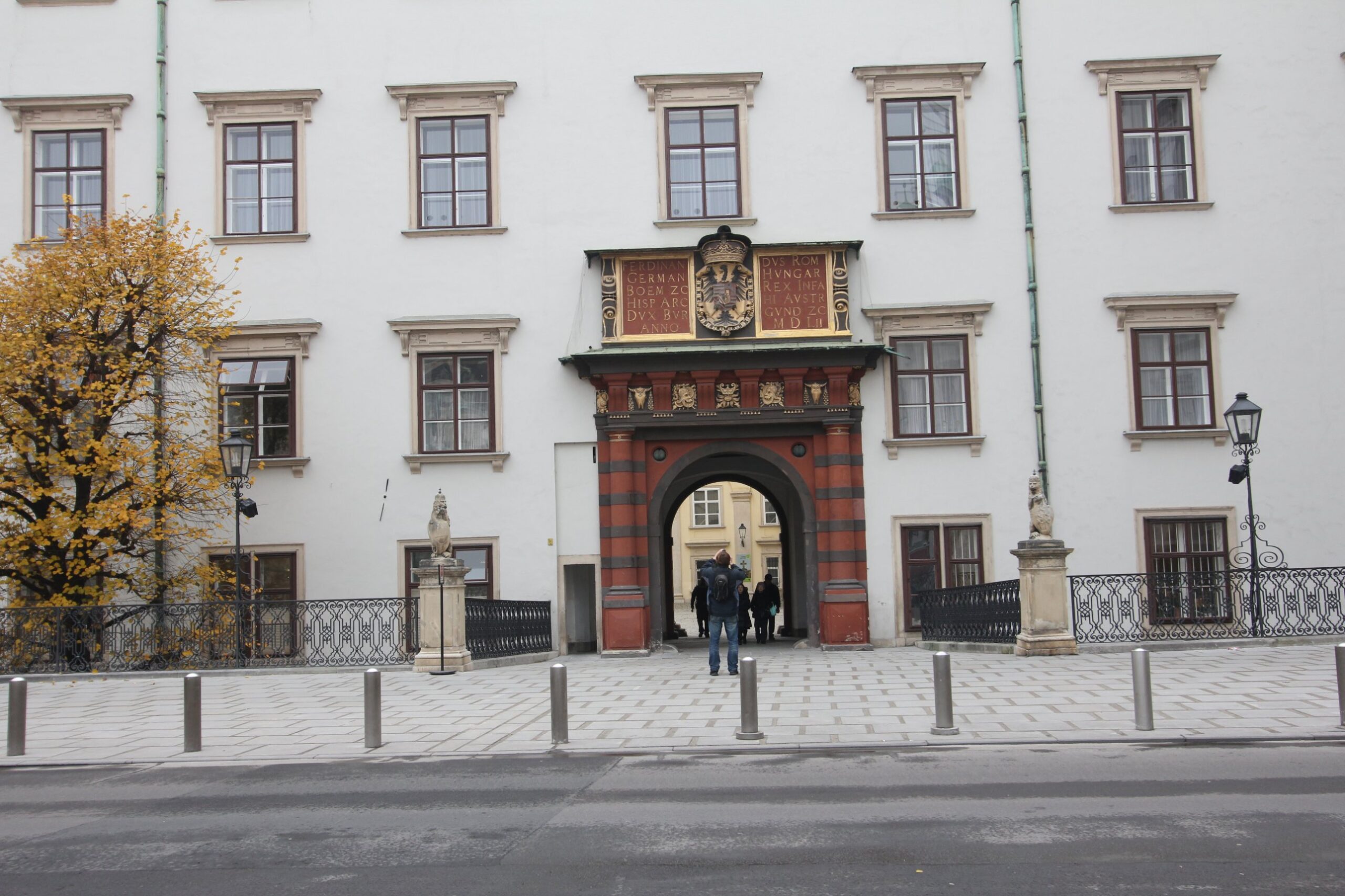
Photo: Virtual Travel Guide
What the inscription says
Above the arch, on two gold-lettered panels either side of the arms, Ferdinand lists his titles:
FERDINANDUS ROM. GERMAN. HUNGAR. BOEM. ETC. REX INFA. HISP. ARCHI. AUSTR. DUX BURGUND. ETC. ANNO MDLII
Spelled out, that's Ferdinand, King of the Romans, of Germany, Hungary and Bohemia, Infante of Spain, Archduke of Austria, Duke of Burgundy, in the year 1552. "King of the Romans" was the title of the emperor-elect. Ferdinand became emperor only in 1558, when Charles V gave up the crown.
The arms in the centre carry the shields of his lands, among them Hungary, Bohemia, Austria, Castile, Burgundy, Aragon, Tyrol and Flanders, ringed by the chain of the Order of the Golden Fleece. On the inner side of the gate the arms sit on a St Andrew's cross, the emblem of Burgundy and of the Order's patron saint. The inner opening carries the date 1553.
A triumphal arch on a castle
The design borrows from Roman triumphal arches. Doric half-columns frame the opening, and the frieze above carries painted stone rosettes and bulls' skulls, a classical motif. It's one of the earliest uses of the Doric order on a portal in Central European Renaissance building.
The court accounts for the project are lost, so nobody can name the designer for certain. The painter Pietro Ferrabosco was paid for the paintings and is usually credited with the design; two other names, Francesco de Pozzo and Johann Tscherte, also appear in connection with the work. Inside the passage, the vault is painted with the arms of Austria, Styria, Carniola, Carinthia and Upper Austria.
The castle's moat was kept, and the gate had a drawbridge. A winch for it is still recorded in 1770, before a masonry bridge replaced it.
Not Swiss, and not quite these colours
The gate has nothing to do with Switzerland in its origins. It took its name in the 18th century from a guard of Swiss soldiers stationed here between 1745 and 1767, under Francis Stephen and Maria Theresa.
The colours have changed too. The original 16th-century scheme was blue-grey, gold and red. It was repainted red and grey in 1763, grey alone in 1853, and red and grey again in 1927. A restoration in 1949 also restored three missing letters of the inscription. What you see today is handsome, but it isn't what Ferdinand saw.
Tradition says that Leopold I had the words "Si deus pro nobis quis contra nos", if God is for us, who can be against us, and the year 1660 added on the inner arch.
Going through
You can walk through the Swiss Gate. On the other side, in the Schweizerhof, are the entrances to the Imperial Treasury and the Burgkapelle. Facing it across In der Burg stands the monument to Emperor Franz.