Imperial Armoury in Vienna, Habsburg Armour From Maximilian I to the Tournament Hall in the Neue Burg
Most visitors to the Neue Burg come for the Weltmuseum and walk past the stairs to the Imperial Armoury. That's a mistake. Upstairs is one of the leading collections of arms and armour in the world, and the museum calls it the best-documented dynastic armoury in the Western world. It is also, on most days, almost empty.
What you get is a procession. Armoured riders on life-size horses line long galleries, in rough date order, from Gothic steel of the 1480s to gilded Renaissance parade armour and on to the hunting and court weapons of the later Habsburgs. Much of it was made for named people, and you can still tell which one fitted whom.
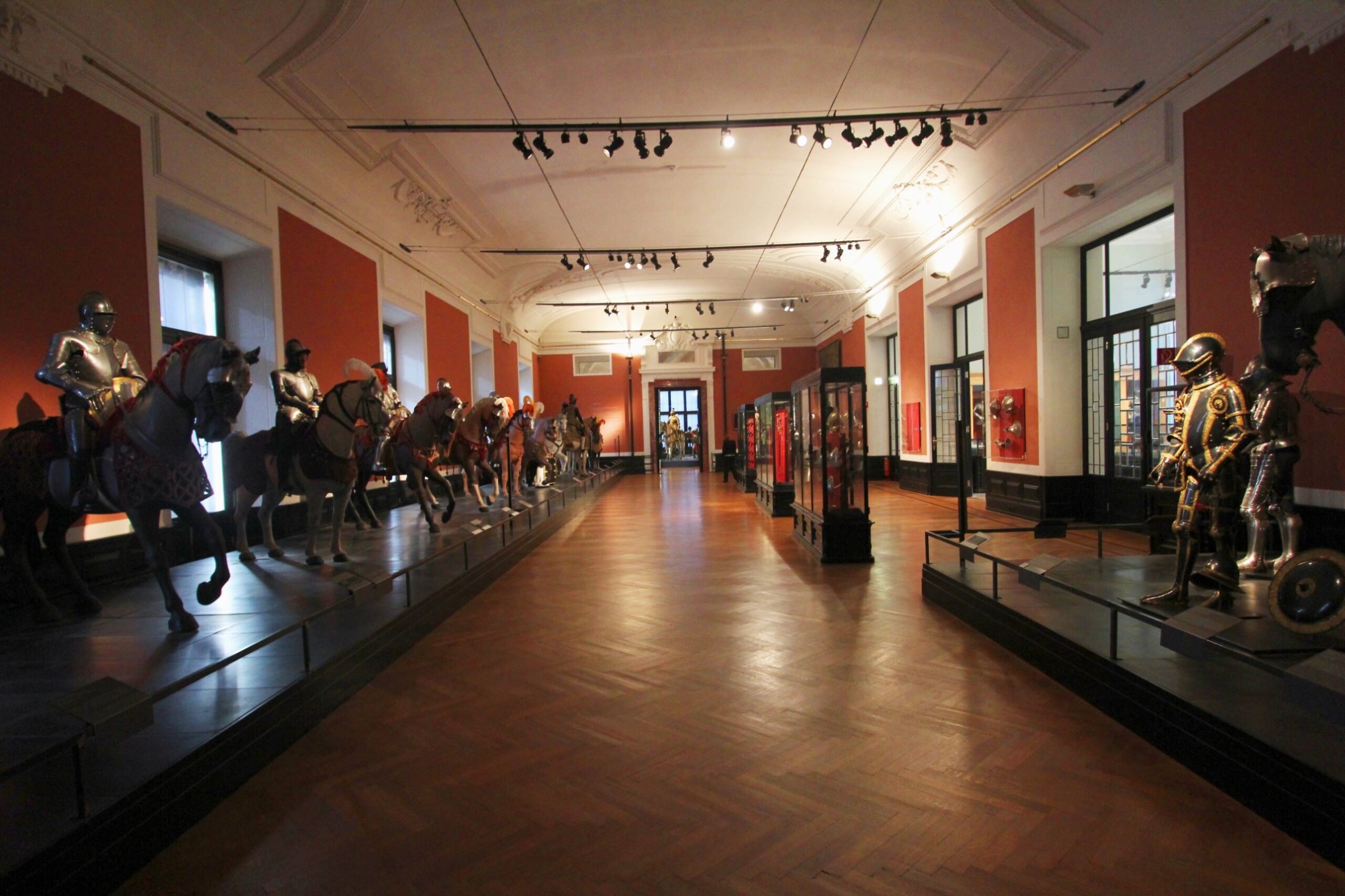
Photo: Virtual Travel Guide
Two armouries made one
The collection has two roots.
One is the court armoury in Vienna, recorded from the early 15th century and kept in the Stallburg, the building that now stables the Lipizzaners, from 1598.
The other, and the reason the collection is so well documented, is Archduke Ferdinand II of Tyrol. At Ambras Castle above Innsbruck he built an "armoury of heroes": the armour of famous commanders, each displayed with a portrait and a life story. In 1601 his secretary Jakob Schrenck von Notzing published it as the Armamentarium Heroicum, 125 engravings of the armours with their owners. The museum calls it the world's first museum catalogue. Rudolf II bought the whole Ambras collection in 1606.
The pieces came to Vienna during the Napoleonic Wars, went on show in the Lower Belvedere from 1814, moved into the new Kunsthistorisches Museum building on the Ring in 1889, and moved again into the Neue Burg in the 1930s. The museum dates the opening there to 1936. It took the name Hofjagd- und Rüstkammer, Imperial Hunting and Armour Chamber, in 1990.
Maximilian and the Gothic rooms
The early rooms belong to Maximilian I and his Gothic armourers.
His Gothic armour for the field, made around 1485 by Lorenz Helmschmid in Augsburg, is the museum's own high point of late Gothic German armour. The Ambras catalogue listed it as the armour of Archduke Sigismund of Tyrol; scholars now give it to Maximilian, who was about 25 when it was made. Maximilian made Helmschmid his court armourer in 1491. The same armourer made the Gothic horse armour on show for Maximilian's father, Emperor Frederick III, in 1477. More on the Gothic armour.
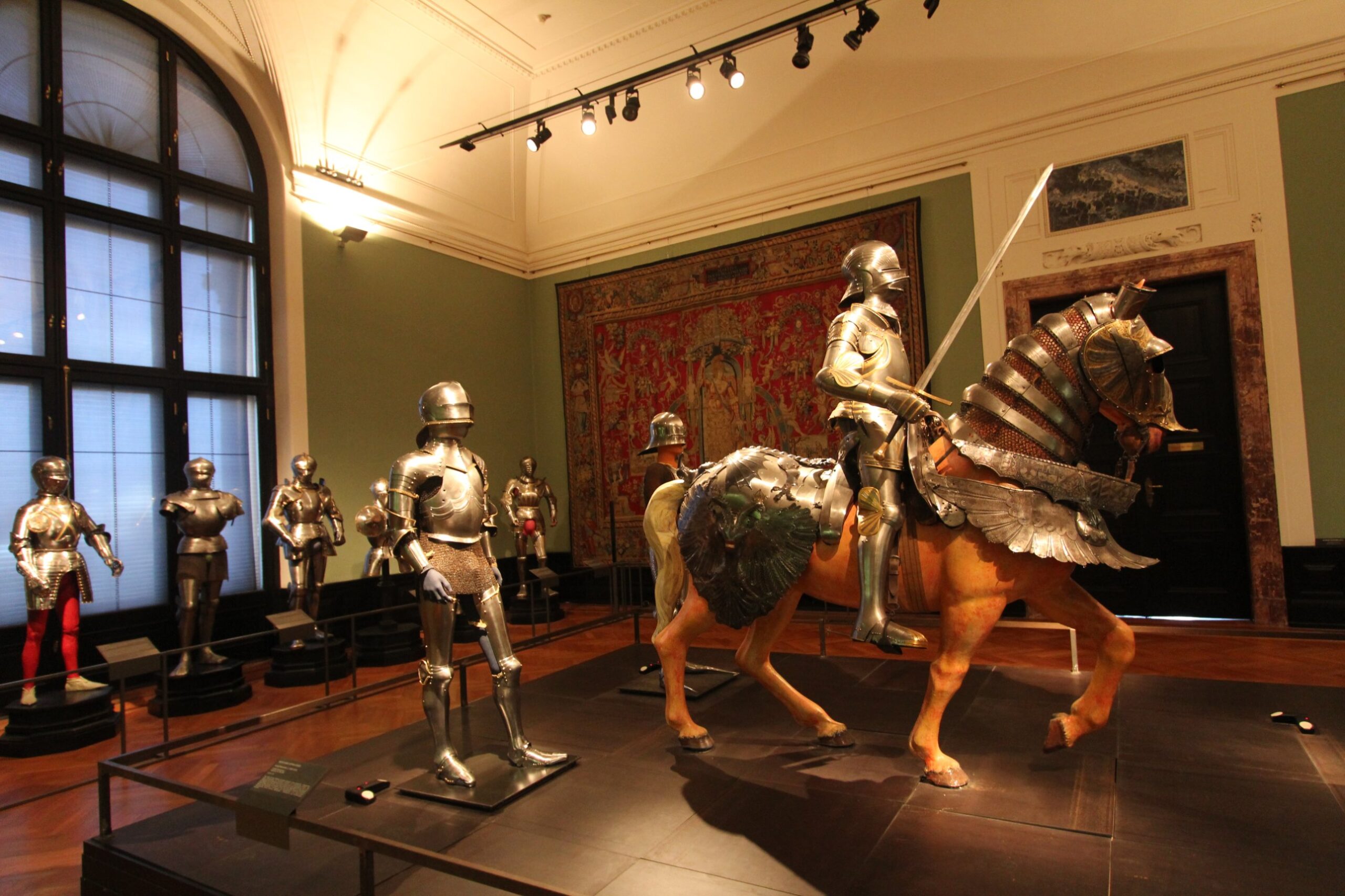
Photo: Virtual Travel Guide
Look along the window walls for the standing armours of the 1510s and 1520s, covered in narrow parallel flutes. Collectors call it "Maximilian armour", after the reign rather than the man; the fluting copies the pleated clothes of the day. One of the best here was made in Innsbruck in 1511, probably for the churchman and diplomat Matthäus Lang. Some helmets of the period have visors hammered into faces, half portrait and half grotesque, to frighten or to amuse.
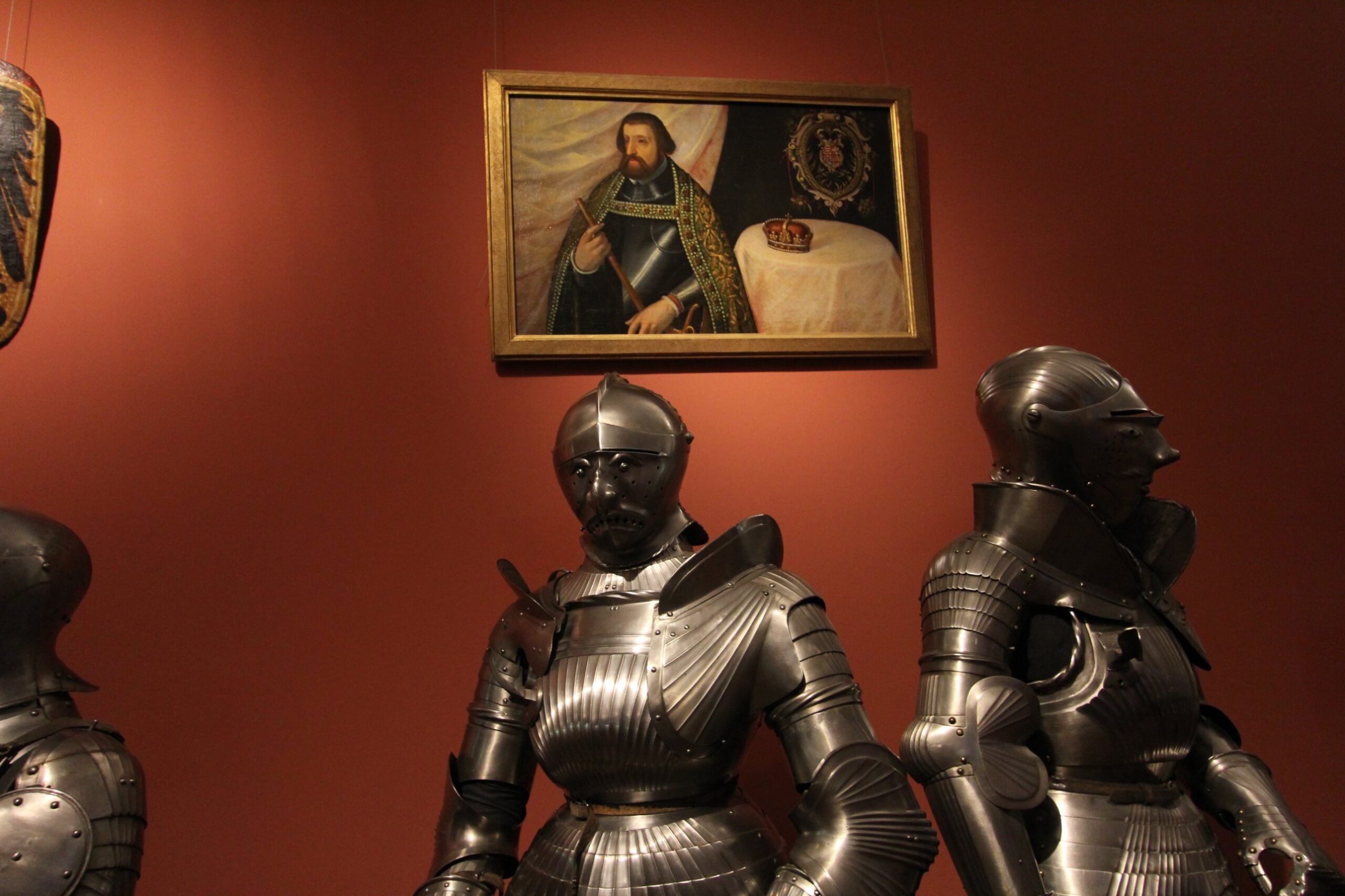
Photo: Virtual Travel Guide
Don't miss the small armour Maximilian ordered in 1512 for his 12-year-old grandson, the future Charles V.
The tournament hall
The tournament gets a room of its own, with riders set up mid-charge.
There were two main kinds of joust. In the Rennen the riders aimed sharp lances at the opponent's shield; it was cheaper and recommended for young noblemen. The Gestech was the elite form, with blunt lances and a special jousting armour, the Stechzeug, that weighed 40 to 45 kilos. In a variant the riders charged along either side of a wooden barrier. The bold striped and chequered horse cloths made each rider easy to pick out. More on the forms of the joust.
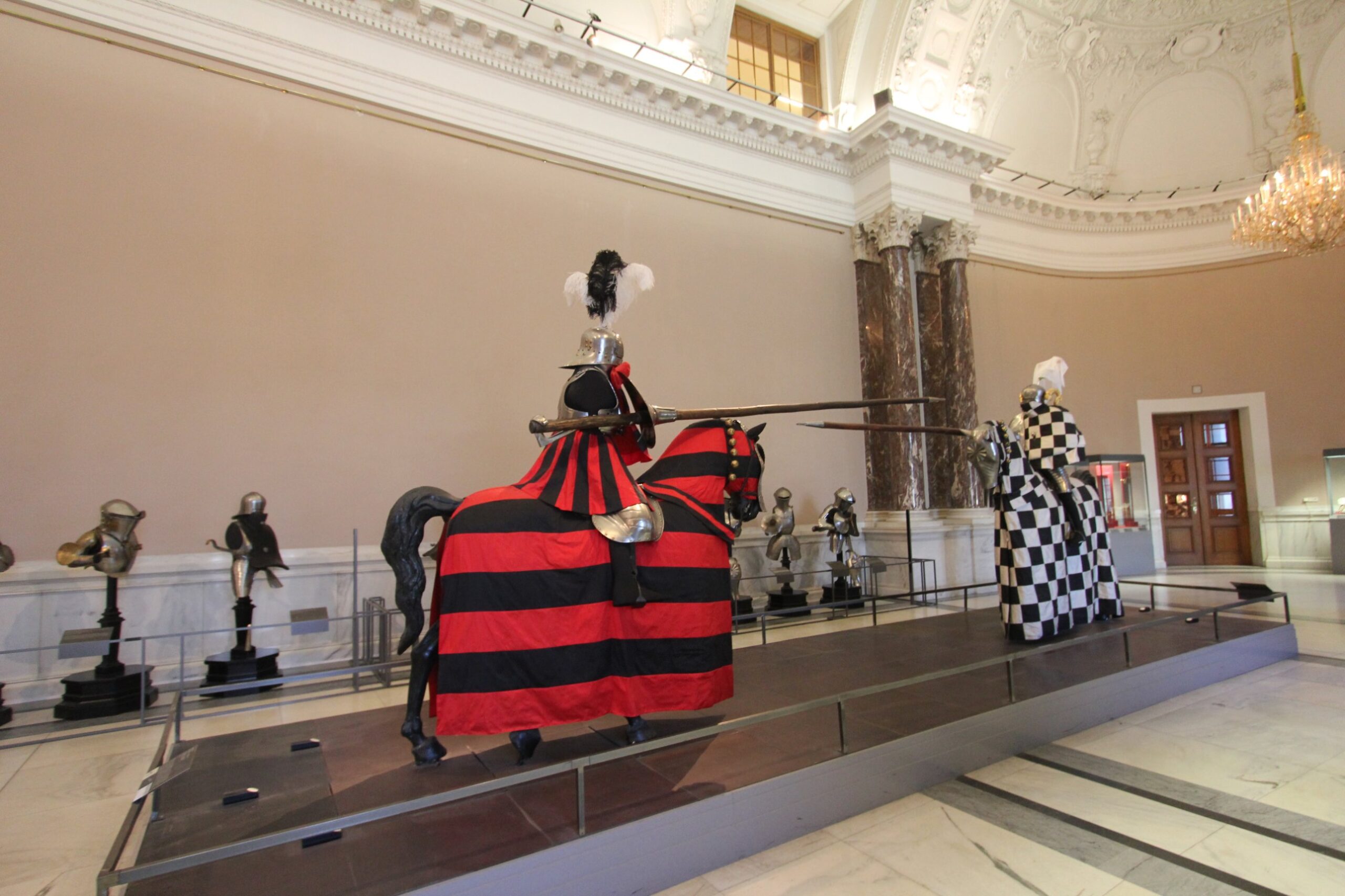
Photo: Virtual Travel Guide
Ferdinand II of Tyrol's wardrobe of steel
The collector had a lot of armour of his own, and it's some of the best in the building.
The Eagle Garniture was ordered in 1546 by his father, Ferdinand I, when he was 17, and made in Innsbruck by Jörg Seusenhofer in 1547. With nearly 90 pieces for field, tournament and parade, the museum calls it the largest Renaissance garniture to survive. It cost 1,258 gold guilders, plus another 463 for the gilding. His "Roman armour", made in Milan around 1547 to 1550 in the circle of Giovan Paolo Negroli, is the only complete all'antica garniture for man and horse that survives. In 1560 he bought a Milanese armour by Giovanni Battista Panzeri for 2,400 kronen, borrowing from the Fuggers and the Welsers to pay for it. More on Ferdinand's armours.
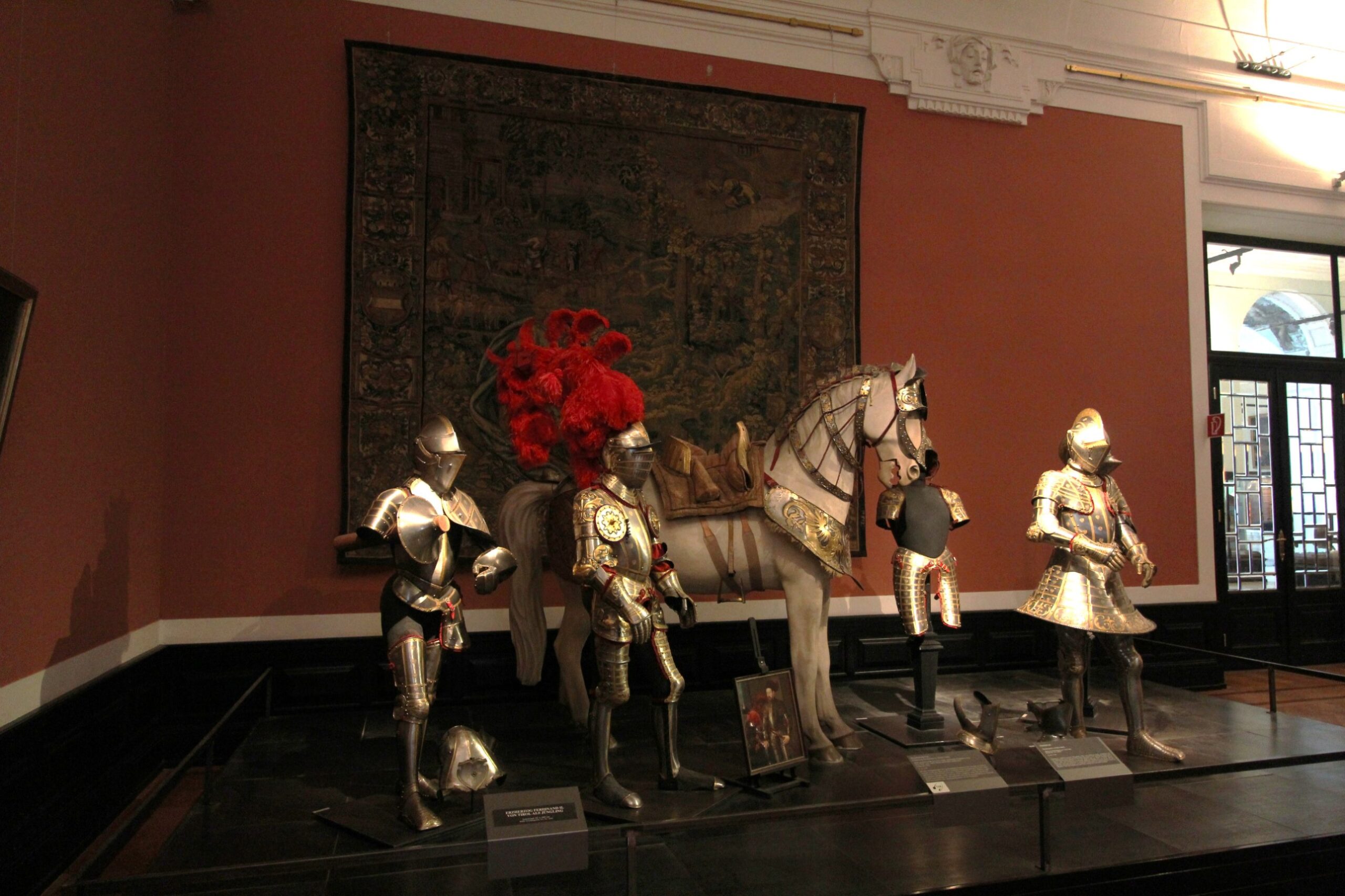
Photo: Virtual Travel Guide
The green rooms carry on with parade armour from other Habsburg courts. Philip II of Spain's field armour, made in Augsburg in 1544 when he was 17, is shown without its helmet: it was lost in a packing mistake in Madrid. Philip gave the armour to Ferdinand in 1571.
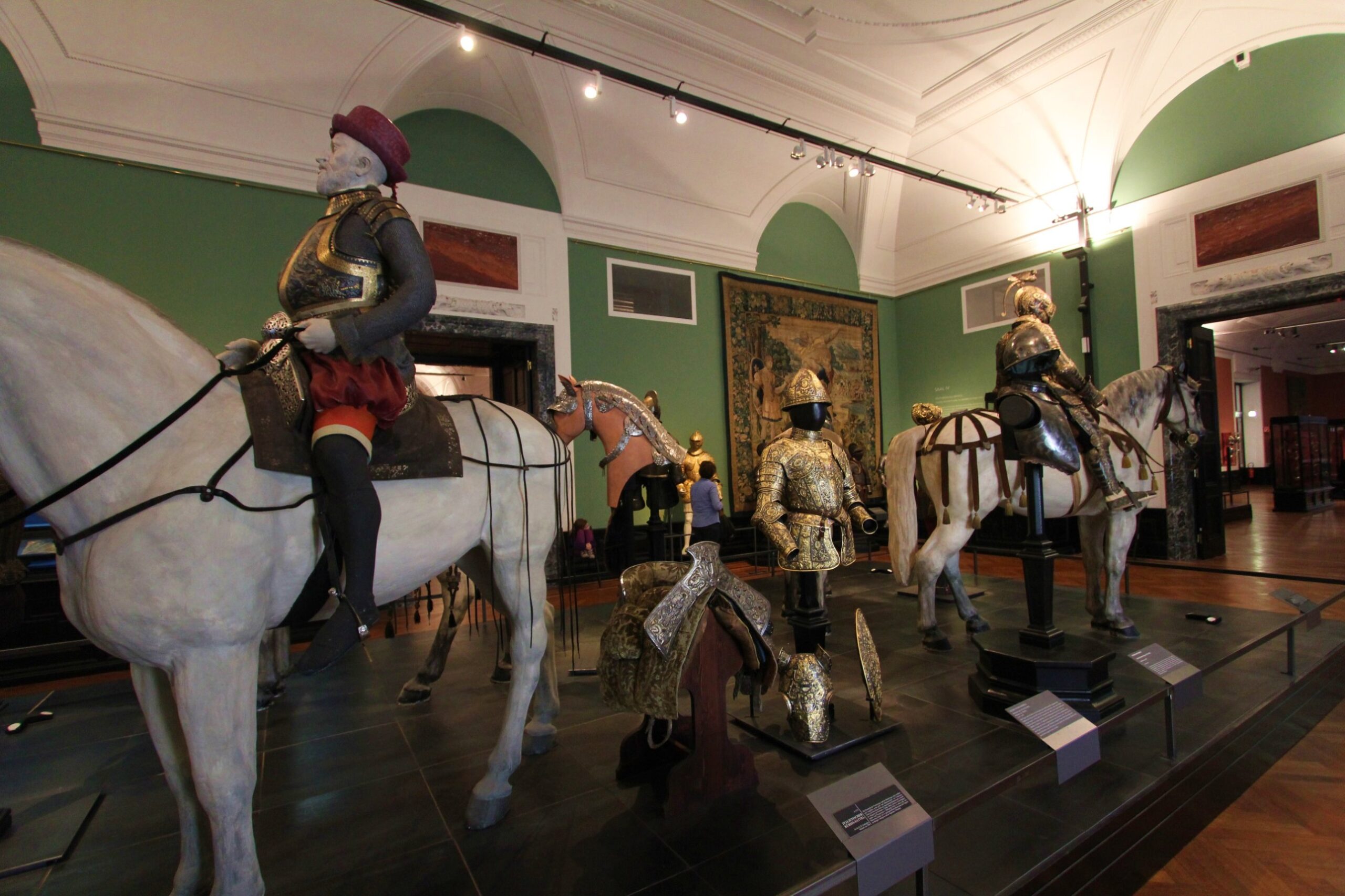
Photo: Virtual Travel Guide
Skanderbeg, and the Ottoman pieces
The pieces visitors ask for most are a helmet and sword linked since the late 16th century to Skanderbeg, the 15th-century Albanian leader who fought the Ottomans for a quarter of a century. The helmet is part of an Italian sallet with a gilt goat's-head crest. The sword was probably made in the Middle East or the Balkans, and its scabbard is inscribed "Scänderwech". The Ambras inventory of 1593 lists a helmet and two swords; the second sword is lost. More on the Skanderbeg pieces.
The museum's Islamic arms came in as diplomatic gifts or spoils of war. A saddle bearing the monogram of Sultan Mustafa II, made between 1695 and 1703, may have been taken at the Battle of Zenta in 1697. Ferdinand's armoury of heroes also had an Ottoman general's armour with its shield, recorded in 1593 as the armour of "the King of Cuba in India".
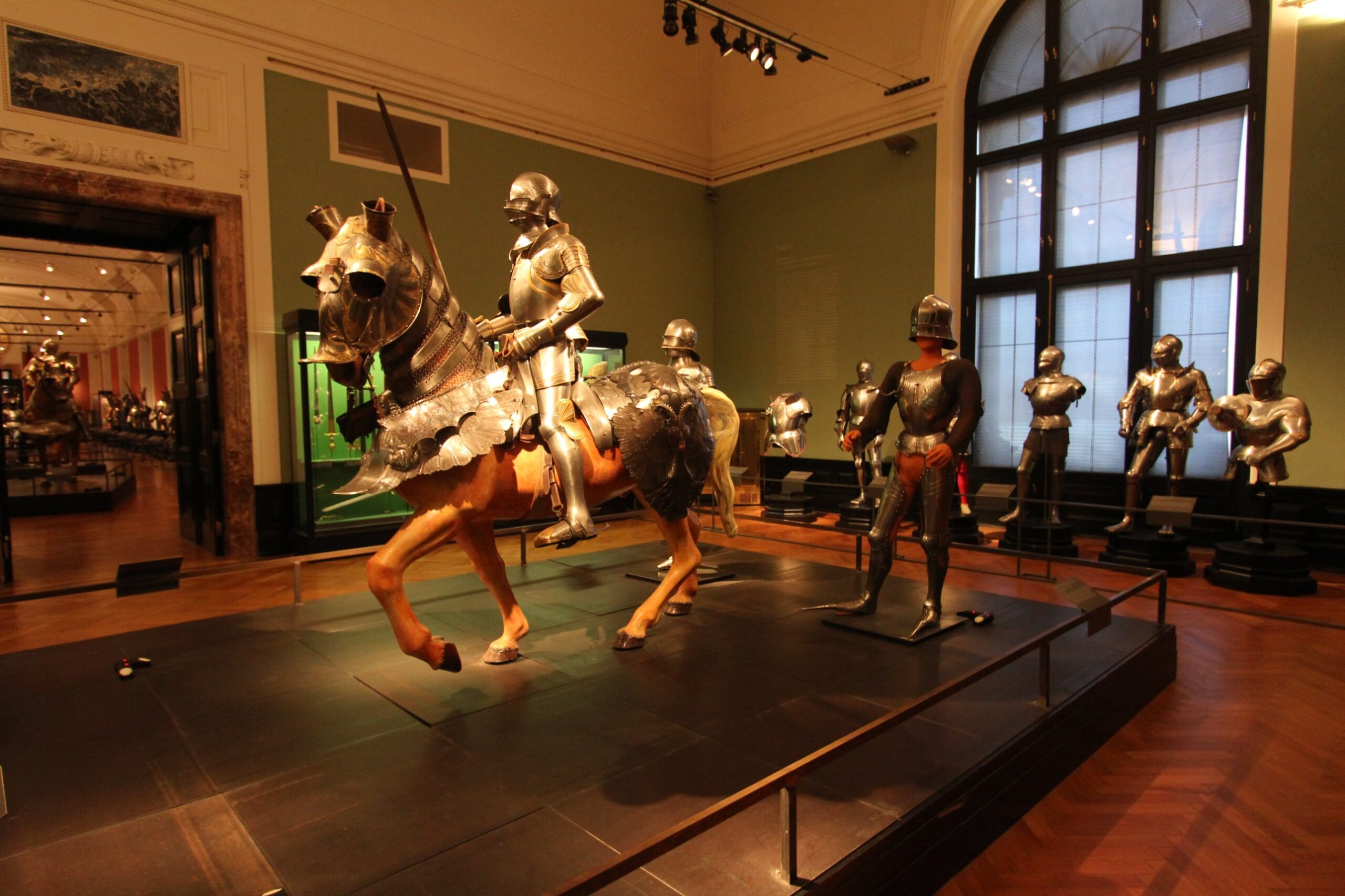
Photo: Virtual Travel Guide
Visiting, as of October 2026
The Armoury has no ticket of its own. The Weltmuseum Wien ticket covers it, along with the Collection of Historic Musical Instruments: adults €16, reduced €12, under 19 free. Entry is by time slot, but you can stay as long as you like.
It's open Tuesday to Sunday, 10:00 to 18:00, and on Tuesdays until 21:00. Closed on Mondays, except 26 October, 21 December and 28 December 2026. Closed on 2 November. On 24 December it closes at 15:00.
Go in through the Weltmuseum entrance in the Neue Burg on Heldenplatz and follow the signs upstairs. Allow an hour to an hour and a half. Most labels are in German, so the audio guide helps.
For the Habsburg treasures in the same palace, see the Imperial Treasury.