Skanderbeg Helmet and Sword in the Imperial Armoury, the Albanian Hero in Vienna
Look at the coat of arms of Albania and above the black double-headed eagle you'll see a helmet with a goat's head on top. The original of that helmet isn't in Tirana. It's in Vienna, in the Imperial Armoury in the Neue Burg, together with a sword, both credited for more than four centuries to Gjergj Kastrioti, called Skanderbeg, the Albanian lord who held off the Ottoman Empire in the 15th century.
How they got here is a story about a Habsburg collector and his hall of heroes.
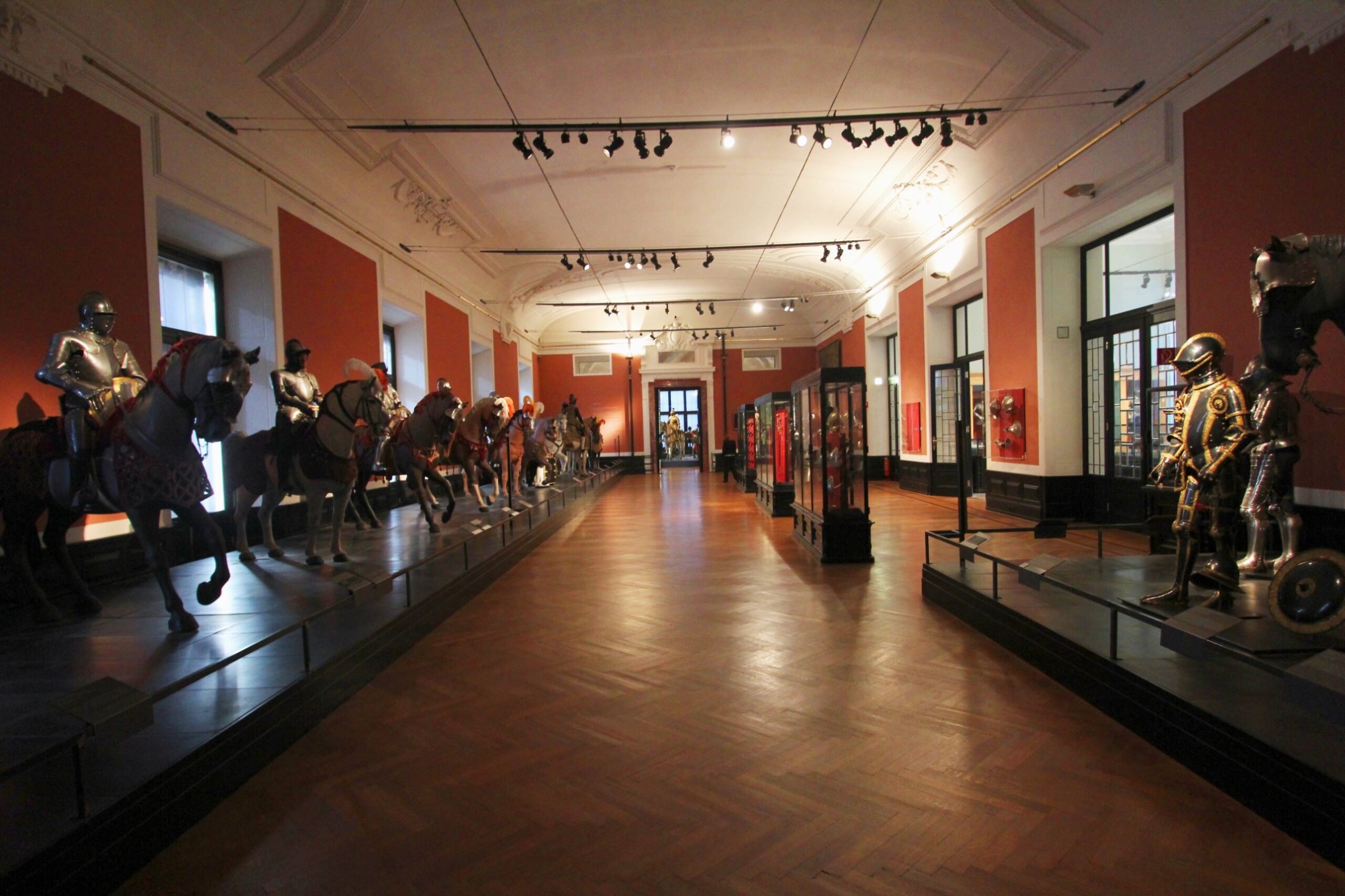
Photo: Virtual Travel Guide
Who Skanderbeg was
Gjergj Kastrioti was born around 1405. As a boy he was sent as a hostage to the Ottoman court, served Sultan Murad II for some twenty years and rose to govern a province. The Ottomans called him İskender Bey, Lord Alexander, which became Skanderbeg.
In November 1443 he deserted during a battle at Niš, went home and took the fortress of Krujë. In March 1444 he brought the Albanian lords together in the League of Lezhë, and for the next quarter of a century he held out against the Ottomans, including two great sieges of Krujë. The pope named him Athleta Christi, champion of Christ. He died in 1468 in Lezhë. He is Albania's national hero.
The helmet
The helmet's steel bowl is part of an Italian sallet, probably from the second half of the 15th century. Its rough-cut edge was already hidden, in the 16th century, under a studded leather band. Round it runs a copper band with an inscription divided by six rosettes. On top, mounted on a later copper plate, sits a goat's head of gilt copper, whose eyes were probably once set with coloured glass or stones. It weighs three kilos.
The sword
The sword has a 15th-century blade, probably made in the Middle East or the Balkans, in a scabbard covered in fish skin. Its handle was probably replaced in the 16th century.
From Ambras to the Neue Burg
Both pieces first appear in the 1593 inventory of Schloss Ambras near Innsbruck, as "Georgen Scanderbegg Helmlin und zwaj Schwerter", the little helmet and two swords of Georg Skanderbeg. They belonged to Archduke Ferdinand II of Tyrol, who built at Ambras a Heroes' Armoury: the armour and weapons of famous commanders of his time and the century before, displayed side by side.
The collection came to Vienna in 1806, was shown in the Lower Belvedere from 1814 and passed to the Kunsthistorisches Museum in 1889. Specialists have argued about the dating and attribution in recent years, so treat the link to Skanderbeg himself as the Ambras tradition, a strong and old one, rather than a certainty.
Why it matters to Albania
Albania's constitution describes the national arms with "the helmet of Skanderbeg" in gold on top of the shield, and the helmet appears on Albanian banknotes. In November 2012, for the centenary of Albanian independence, the museum lent the helmet and sword to the National History Museum in Tirana for 45 days. Then they came back to Vienna.
Seeing them
The helmet and sword are in the Imperial Armoury on the first floor of the Neue Burg. See our Armoury guide for the rooms, and our post on Archduke Ferdinand II's armours for the man who brought them together.