Armours of Archduke Ferdinand II of Tyrol in the Imperial Armoury, the Eagle Garniture and the Roman Armour
A good part of the Imperial Armoury in the Neue Burg exists because of one man. Archduke Ferdinand II of Tyrol collected armour the way other princes collected paintings, and he collected his own as well: suits made for him as a teenager, as regent of Bohemia, as ruler of Tyrol and as a bridegroom. Several of them stand together in the Armoury today.
They show the range of what a Renaissance armourer could do, from heavy field and tournament steel to costume armour made to look ancient Roman.
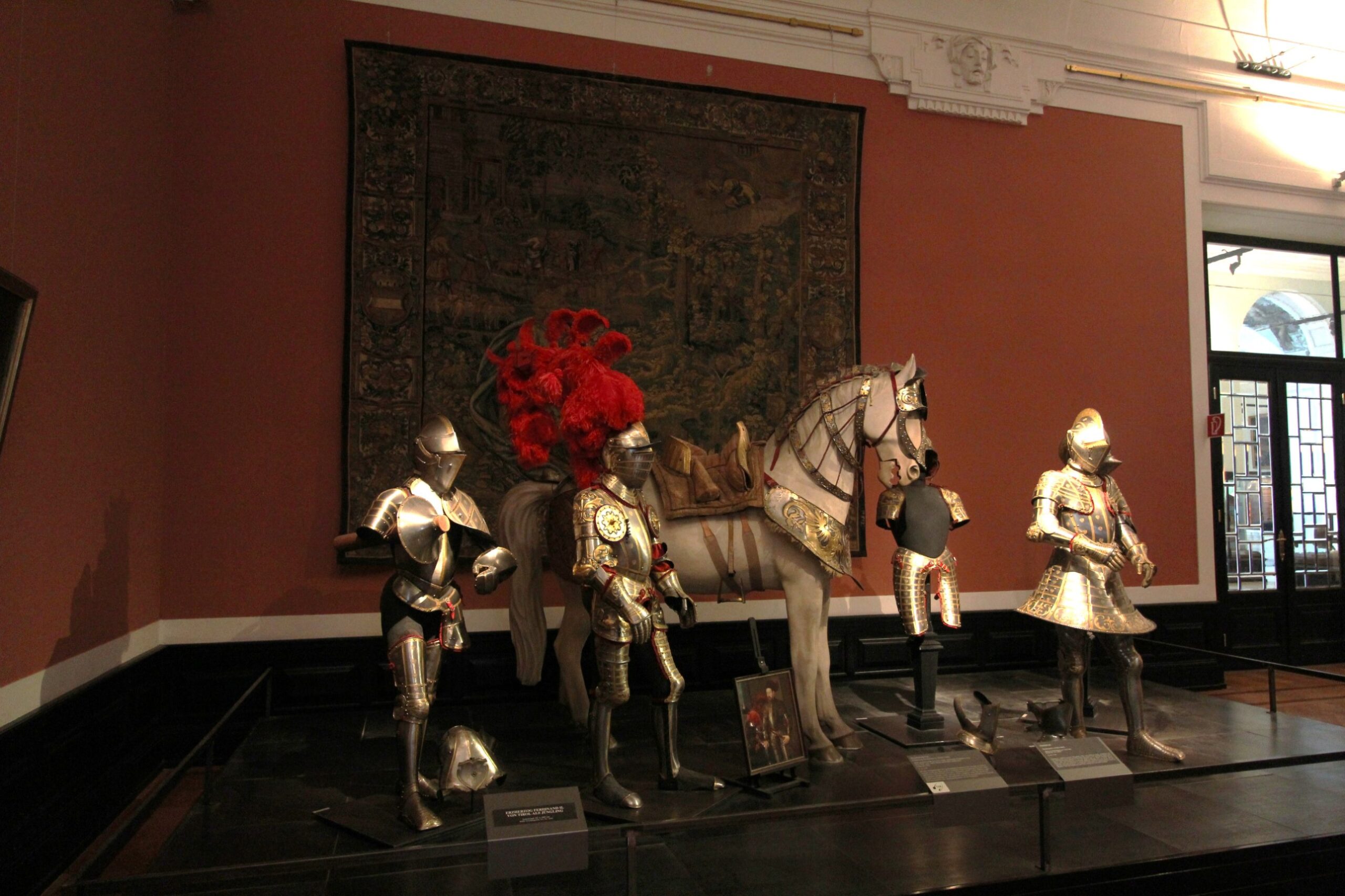
Photo: Virtual Travel Guide
The collector
Ferdinand was born in Linz in 1529, the second son of Emperor Ferdinand I and younger brother of the future Maximilian II. At 18 his father made him governor of Bohemia, and he stayed in Prague until 1567. In 1564 he became ruler of Tyrol and Further Austria and moved his court to Innsbruck.
His private life was unconventional for a Habsburg. In 1557 he secretly married Philippine Welser, the daughter of an Augsburg patrician family, far below his rank. His father accepted the marriage in 1559 on condition that it stay secret, and their sons were excluded from the succession. After Philippine died in 1580, he married his niece Anna Caterina Gonzaga of Mantua in 1582.
At Schloss Ambras above Innsbruck he built one of the first museums in Europe: a cabinet of curiosities, a portrait gallery and armouries. In 1565 alone, some 17 tonnes of arms were moved from Prague to Innsbruck. The collections nearly bankrupted him. In 1806 the Ambras armour came to Vienna, and that is the core of what you see in the Neue Burg now.
The Eagle Garniture
The star piece is the Eagle Garniture, made in 1547 by the Innsbruck armourer Jörg Seusenhofer, with etching by the painter Hans Perkhammer. Ferdinand I ordered it the year before, during the Schmalkaldic War, for his son, then 17.
A garniture is a kit rather than a single suit: a basic armour plus exchangeable pieces, so the same harness could be built up for battle or for different kinds of joust. This one ran to about 90 pieces, and the museum calls it the largest surviving Renaissance garniture. Its name comes from the single-headed Austrian eagle etched on almost every piece. On its figure it stands 2.16 metres with the plume.
The Roman armour
Beside the battle steel stands something quite different, recorded at Ambras in 1583 simply as a "Roman Armour". It was made in Milan around 1547 to 1550, in the style of Giovan Paolo Negroli or his circle, for man and horse, and the museum describes it as the only complete all'antica garniture for both to have come down to us.
The helmet's brim and front form a monster's face, and its crest is shaped like the scaly body of a creature whose head is now lost. The mail is made of tiny rings, about three millimetres across, mixing iron and brass wire into patterns. Ferdinand was about 20 and regent of Bohemia when he ordered it, probably for festivities rather than fighting.
The Milanese armour and the wedding armour
Two more pieces fill out the story. A half-armour with horse bard, shield, mace, sword and boar spear was made in Milan in 1559 or 1560 by Giovan Battista Panzeri, called Serabaglio, with gold and silver damascening by Marc Antoni Fava. Ferdinand bought it for 2,400 kronen with help from Anton Fugger and the Welser bank. The young Gustav Klimt sketched it in the 1880s, when it was shown in the Lower Belvedere.
And for his second wedding in 1582 he had a German armour made in the antique style, with lion heads on the shoulders: a middle-aged bridegroom presenting himself as a hero of Troy.
Seeing them
The armours are in the Imperial Armoury on the first floor of the Neue Burg, entered through the Weltmuseum. See our Armoury guide for how the rooms run, and our Innsbruck Hofburg guide for the city where Ferdinand built his collection.