Tournament Armour in the Imperial Armoury, How the Gestech and the Rennen Were Fought
In one long, marbled hall of the Imperial Armoury, knights sit on armoured horses in full tournament dress, plumes on their helmets and painted caparisons to the horses' knees. It looks like a single kind of event. It wasn't. Around 1500 the joust came in a dozen varieties, each with its own rules, lance and armour, and the court of Emperor Maximilian I developed several of them.
The Vienna collection is one of the best places anywhere to see the difference.
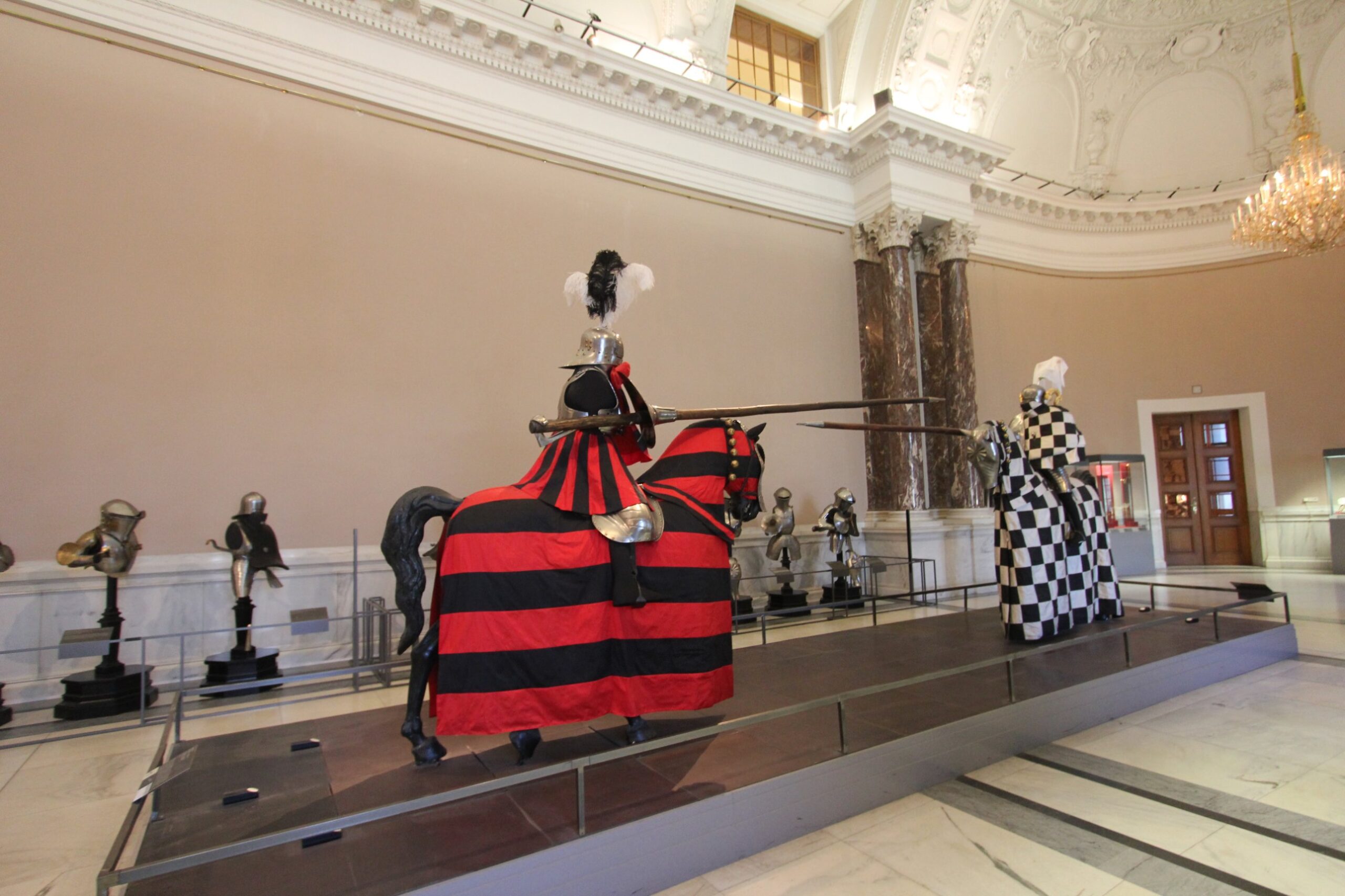
Photo: Virtual Travel Guide
The Gestech, the joust of peace
In the Gestech, or Stechen, two riders met with blunted lances. The aim was to break the lance on the opponent or knock him out of the saddle. The lance ended in a coronel, a small crown of three or four blunt prongs that gripped the armour without piercing it.
Around 1500 there were two styles. In the German joust the riders charged with nothing between them. In the Italian joust, the Welsches Gestech, a wooden barrier, the tilt, kept the horses apart.
The armour for it, the Stechzeug, was built for one purpose: to survive a heavy hit square on the chest. The helmet was screwed to the breast and back so the head couldn't snap back, and there was no leg armour, because blows below the belt were against the rules. One Innsbruck example in the collection, from about 1480, weighs around 45 kilos for the armour alone, roughly twice a field armour.
The Rennen, the joust of war
The Rennen was faster and lighter, a test of riding and lance handling, and it was fought with sharp lances. Its armour, the Rennzeug, was probably developed at Maximilian's court around 1490: an asymmetrical breastplate with a rest and counter-hook for the lance, a lighter back, a sallet helmet and a chin defence. A large shield, the Renntartsche, was fixed to the left breast.
The Armoury has a Rennzeug made by Matthes Deutsch of Landshut in 1498, with the Burgundian cross and fire-steel on its helmet, possibly a gift to Maximilian or his son Philip the Handsome around a Rennen held in Innsbruck that February.
The exploding shield
The most theatrical piece is a mechanical breastplate of about 1490, owned by Maximilian. Two levers, two brass rollers and a hidden spring held the shield in place. A solid lance hit released it, and the shield flew into the air over the rider's head, in some versions throwing off iron plates as well. The crowd saw the hit. The rider stayed in his saddle.
Freydal, the book of tournaments
Maximilian had his own tournaments recorded in Freydal, a picture book planned from 1502 and painted between 1512 and 1515, now in the collection of the Kunsthistorisches Museum. Of 256 miniatures, 255 survive. They show 64 tournaments, each in four scenes: two mounted jousts, one fight on foot and one masked dance, and they name eleven kinds of joust. It is part of the emperor's great memorial programme and is on UNESCO's Memory of the World register.
Seeing them
The tournament hall is in the Imperial Armoury on the first floor of the Neue Burg. See our Armoury guide for the layout, and the Gothic armour of Maximilian I for the field armour of the emperor who loved the joust most.