Charles VI as Hercules of the Muses, the Marble Emperor Under the Dome of the State Hall in Vienna
Walk to the middle of the State Hall of the Austrian National Library and you're standing in front of the man who paid for it. Emperor Charles VI stands on a pedestal under the dome, larger than life, in white marble, presented as Hercules Musarum, the Hercules of the Muses.
It's a strange role for a Habsburg emperor and a deliberate one. Hercules was the hero of strength and labour. Put him in charge of the Muses and you have a ruler whose power serves learning, which is how Charles wanted to be seen in his library.
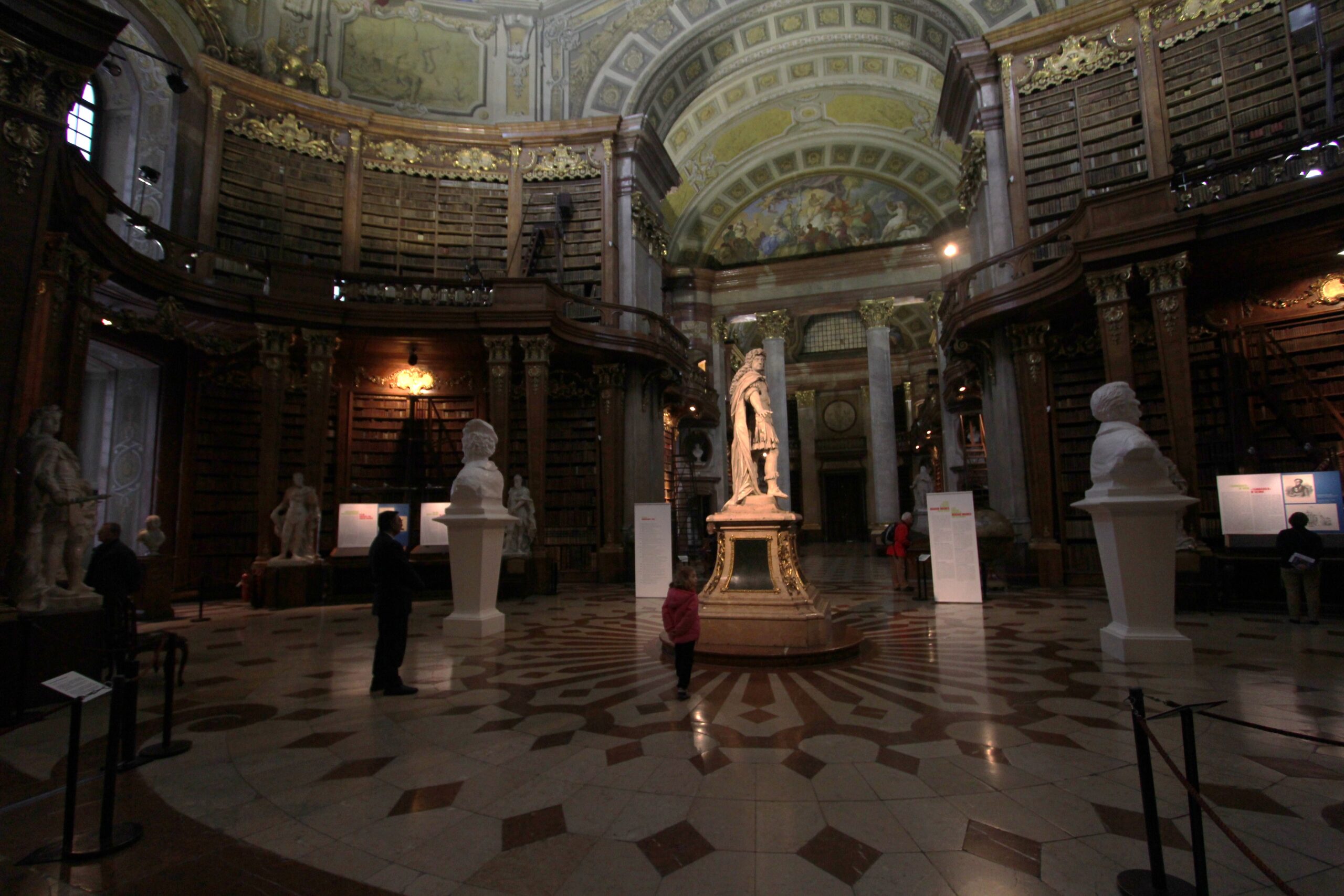
Photo: Virtual Travel Guide
The statue
The library dates it to 1735 and attributes it to Antonio Corradini, imperial court sculptor, a Venetian who later made his name with veiled marble figures. The library's own wording is careful, "allegedly", and the attribution is not fully settled.
It stands at the centre of the oval under the dome, where the long hall widens. The four great Coronelli globes stand around it, and the shelves of the central oval behind it hold the library of Prince Eugene of Savoy, about 15,000 volumes that came to the court library in 1737, the year after his death.
Hercules twice
Look up. Daniel Gran's dome fresco, painted between 1726 and 1730, is an apotheosis of the same emperor. At its centre a medallion with Charles's portrait is held up by Hercules and Apollo, with Fame above. Around them are groups for the four university faculties, the gratitude of scholars and artists, History with Time, and Peace with Minerva and Trade. The fresco also tells, in allegory, the story of how the library was built.
So Hercules appears twice: once in paint, holding up the emperor's portrait, and once in marble below, as the emperor himself. The room is a single argument about Charles VI.
The dome is about 30 metres high. In 1767, under Maria Theresa, Nikolaus Pacassi put an iron ring round it to stop it cracking further, and Franz Anton Maulbertsch restored the fresco in 1769.
The Habsburg family around him
Charles isn't alone. More marble Habsburgs line the hall, Austrian and Spanish, from medieval dukes to the 17th century: Rudolf IV the Founder, Philip II of Spain, Don Juan of Austria, Ferdinand III and others, with Charles himself appearing a second time as King Charles III of Spain, the crown he fought for and lost.
These are older than the room. In 1696 Charles's father, Leopold I, commissioned the sculptor Paul Strudel to carve a series of life-size Habsburgs. Nobody now knows where Leopold meant to put them. Paul worked on them with his brothers Peter and Dominik, and decades later the series found a home here. Others from the same series are in the Franzensburg at Laxenburg, south of Vienna.
The founder
Charles VI commissioned the library building. Johann Bernhard Fischer von Erlach designed it and, after his death in 1723, his son Joseph Emanuel built it between 1723 and 1726. The library quotes Charles's house rules for readers: "The client does not have to pay, he should leave the place richer and return many times."
About 200,000 books from 1501 to 1850 still fill the shelves around him.
For tickets, hours and the rest of the hall, see our guide to the State Hall. For the globes around the statue, see the Coronelli globes.