Joseph II Equestrian Statue on Josefsplatz, the Reformer Emperor Dressed as Marcus Aurelius
Josefsplatz is one of the most complete Baroque squares in Vienna: the white front of the court library on one side, palace wings on two more, and in the middle a bronze emperor on horseback with his right hand raised. He's Joseph II, Maria Theresa's eldest son, the reforming emperor who wanted to change everything in ten years and almost did.
The statue doesn't look much like him. That was the point, and it was also the complaint.
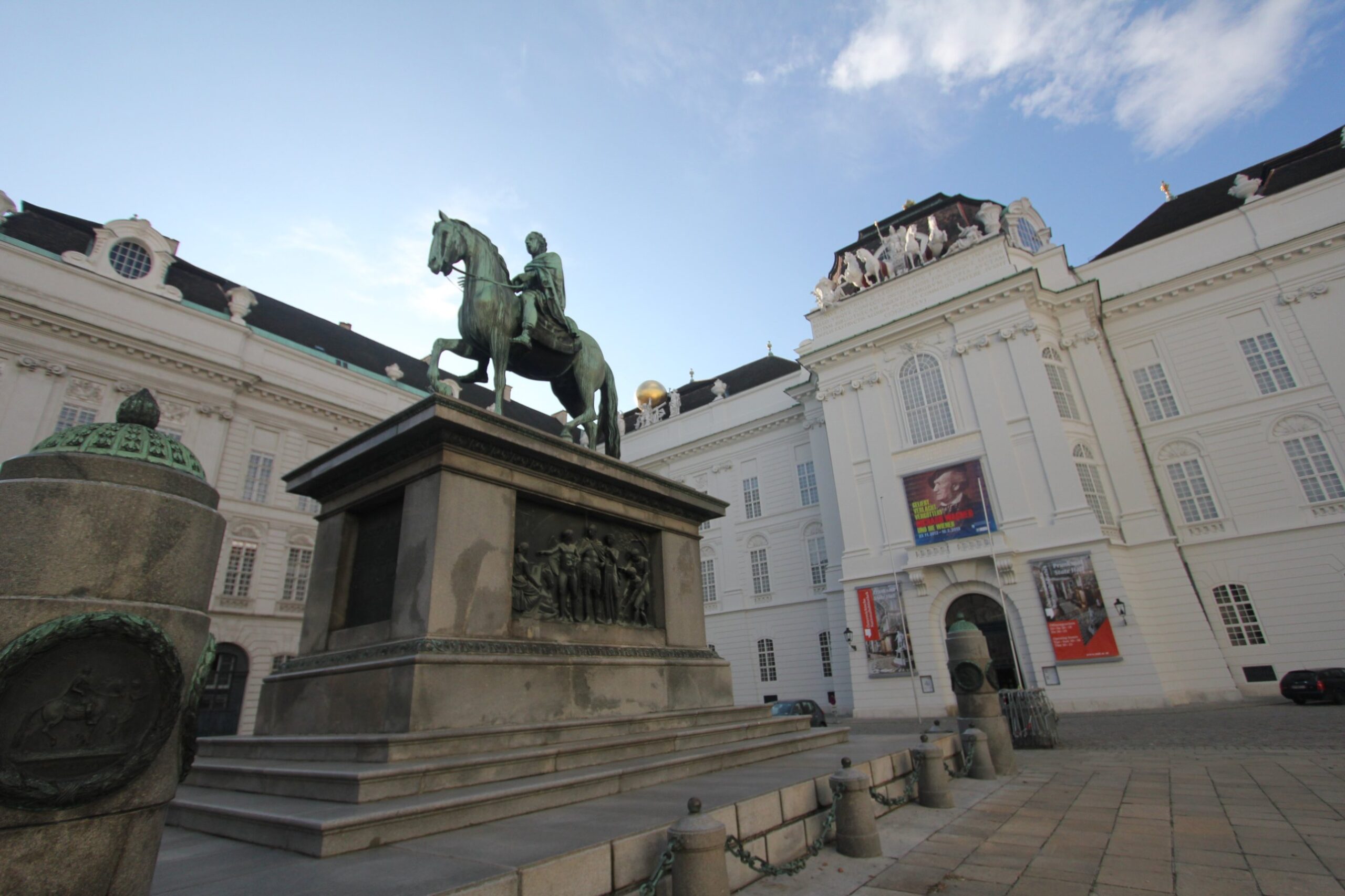
Photo: Virtual Travel Guide
An emperor as an ancient Roman
The idea came soon after Joseph died in 1790, and his nephew, Emperor Franz, commissioned it from the sculptor Franz Anton Zauner. Zauner modelled it on the most famous equestrian statue of antiquity, the Marcus Aurelius on the Capitol in Rome. So Joseph rides bareheaded, bare-legged, in a Roman riding cloak, raising his hand in greeting.
Contemporaries who remembered the real Joseph, a famously unceremonious emperor, found it remote. The poet Franz Grillparzer said as much in a poem of 1842.
Casting it
Zauner worked on it from 1795 to 1807 at the Academy of Fine Arts, and he cast it himself, after teaching himself the whole process. Vienna had mostly given up bronze for lead casting by then. He made a small version of the full monument first, then cast the rider around 1800 and the horse around 1806, both at twice life size, at the cannon foundry in the Wieden suburb. It was said at the time to be the largest casting made outside France.
It was unveiled in November 1807, in the emperor's presence. Zauner was ennobled for it.
The pedestal
The pedestal is polished granite from Mauthausen, surrounded by a bronze chain. Two reliefs show Joseph's promotion of trade and agriculture, and medallions on the corner posts recall moments of his reign.
The Latin inscription on the front is the best short obituary of any Habsburg:
IOSEPHO II QUI SALUTI PUBLICAE VIXIT NON DIU SED TOTUS
To Joseph II, who lived for the public good, not long, but wholly.
He reigned alone for only ten years, from his mother's death in 1780 to his own in 1790. In that time he eased serfdom, issued edicts of toleration for Protestants, Orthodox Christians and Jews, closed hundreds of monasteries, founded the General Hospital, and tried to run an empire of many languages from one desk in Vienna. Much of it was undone after he died. The inscription is generous about that.
The square
The square was named after him in 1786, while he was still alive. Before that it had been a riding ground beside the court, and earlier a garden. Joseph opened it to the public in 1783. Around the statue are the State Hall of the National Library, the Redoutensäle, Palais Pallavicini, whose portal figures are also by Zauner, and Palais Pálffy. Film fans know the square too: Harry Lime's staged accident in The Third Man happens here.
The Augustinian Church, where Joseph's parents married, is on the corner.