Coronelli Globes in the State Hall, the Four Baroque Globes Under the Library Dome in Vienna
Under the dome of the State Hall, around the marble emperor in the middle, stand four big globes. Most visitors give them a glance on the way to the frescoes. They're worth longer. They were made by Vincenzo Coronelli, the Venetian friar whose globes were sought by courts across Europe, and each is 110 centimetres across.
They come in two pairs. Coronelli gave one pair to Emperor Leopold I. A second, almost identical pair belonged to an emperor Francis I, almost certainly Francis Stephen, Maria Theresa's husband, and was also in the court collection. In the early 18th century both pairs were set aside for the new library hall and placed under the central dome, where they still stand.
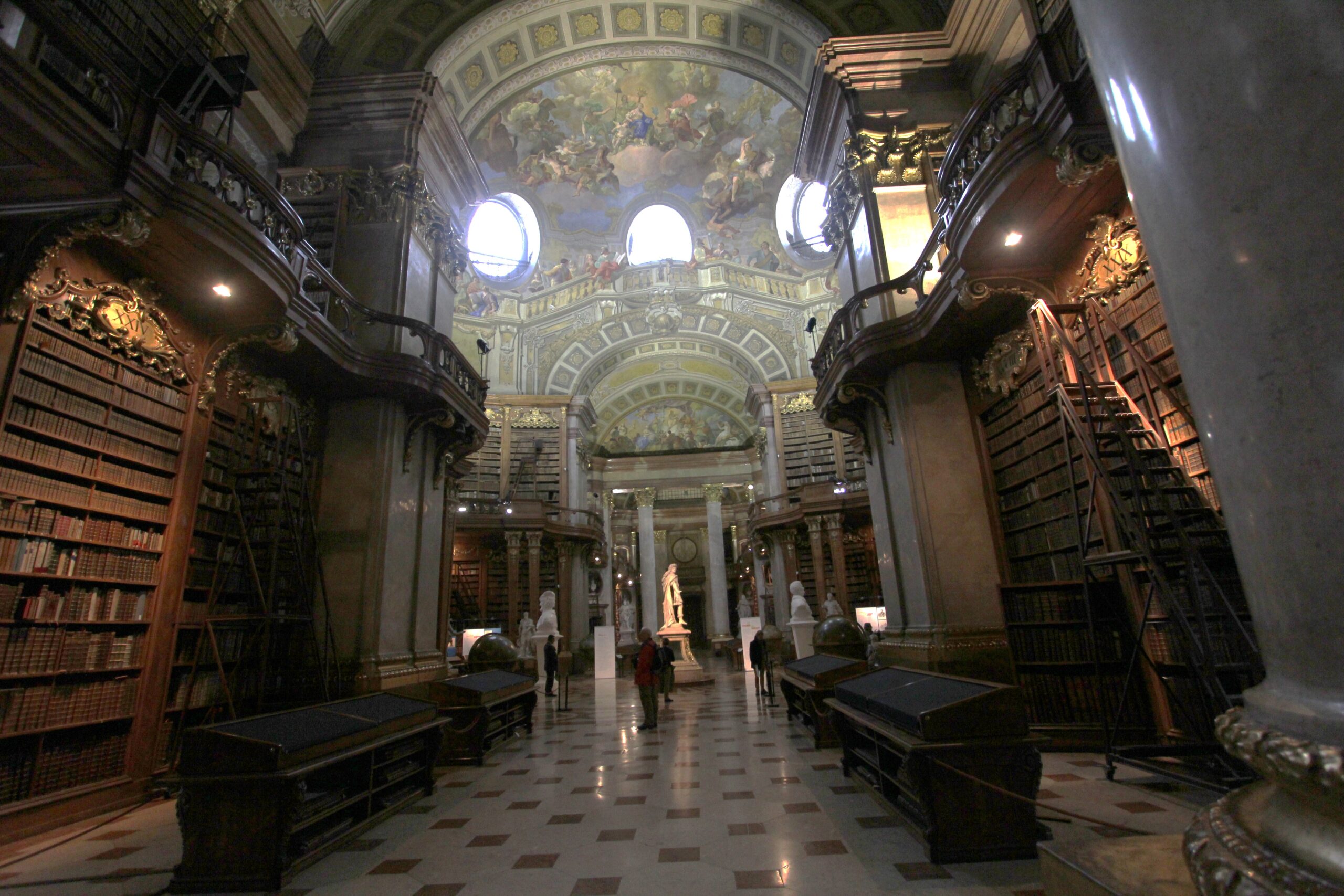
Photo: Virtual Travel Guide
The friar who mapped the world
Vincenzo Coronelli was born probably in Venice in 1650 and died there in 1718. He joined the Conventual Franciscans at 13, and the Republic of Venice made him its official cosmographer. In 1693 he published the Libro dei Globi, a book of the globe gores he printed, the curved strips of map you paste onto a sphere.
His fame came from Paris. In 1681 Cardinal César d'Estrées invited him to make a pair of globes for Louis XIV, and he spent two years on them. They are nearly four metres across and weigh about two tonnes each. They were meant for Versailles, stood at Marly for a time, and are now in the west hall of the French national library at its François-Mitterrand site.
The Vienna globes are smaller versions of the kind of work he sold across Europe's courts and monasteries. A study of Coronelli's surviving globe pairs in Vienna, Melk, Vorau and Trier dates them to 1688 and 1693. Which date belongs to which of the Vienna globes isn't published.
What you're looking at
A Coronelli globe is a printed map, cut into curved strips, pasted onto a sphere and coloured by hand. One made in the 1680s or 1690s shows the world as Europe knew it then, with confident coastlines in the Mediterranean and a lot of guesswork further out. Pairs of globes usually set the earth beside the heavens, though the library doesn't say which of these four is which.
The Vienna pairs were gifts and court property, not scientific instruments for daily use. Standing under Gran's dome around a statue of the emperor, they make the same point as the rest of the room: the world, and the knowledge of it, laid out in the emperor's house.
The museum next door
In 1921 the geographer Eugen Oberhummer made an inventory of the globes in the State Hall: the two Coronelli pairs, a smaller pair by Blaeu and two large gilded globes on the façade. The next year they were put in the care of the library's new geographical collection, the department that later opened the Globe Museum. The Coronelli pairs stayed where they were, under the dome.
The Globe Museum is a five-minute walk away, in Palais Mollard at Herrengasse 9. It opened in 1956 with 63 pieces built on the private collection of Robert Haardt, and moved to Palais Mollard in 2005. It turned 70 in September 2026 and opened a new multimedia room for the anniversary. The library calls it the only museum of its kind in the world. It now holds more than 800 objects, about 250 of them on show, including a Coronelli room, a terrestrial globe by Gemma Frisius from about 1536 and Mercator's pair of 1541 and 1551.
The library's week ticket covers the State Hall and the Globe Museum. See our State Hall guide for prices, and the statue of Charles VI the globes stand around.