Rooftop Sculptures of the National Library on Josefsplatz, Minerva in Her Chariot and the Two Golden Globes
Most people on Josefsplatz look at the bronze emperor on his horse, then at the doors of the State Hall, and go in. Very few look up. They should. On the roof of the old court library there's a whole sculptural argument about knowledge: a goddess in a four-horse chariot crushing ignorance, and two golden globes, one for the heavens and one for the earth.
It was all put up in 1726, when the library was finished, and it tells you what the building was for before you've read a single label.
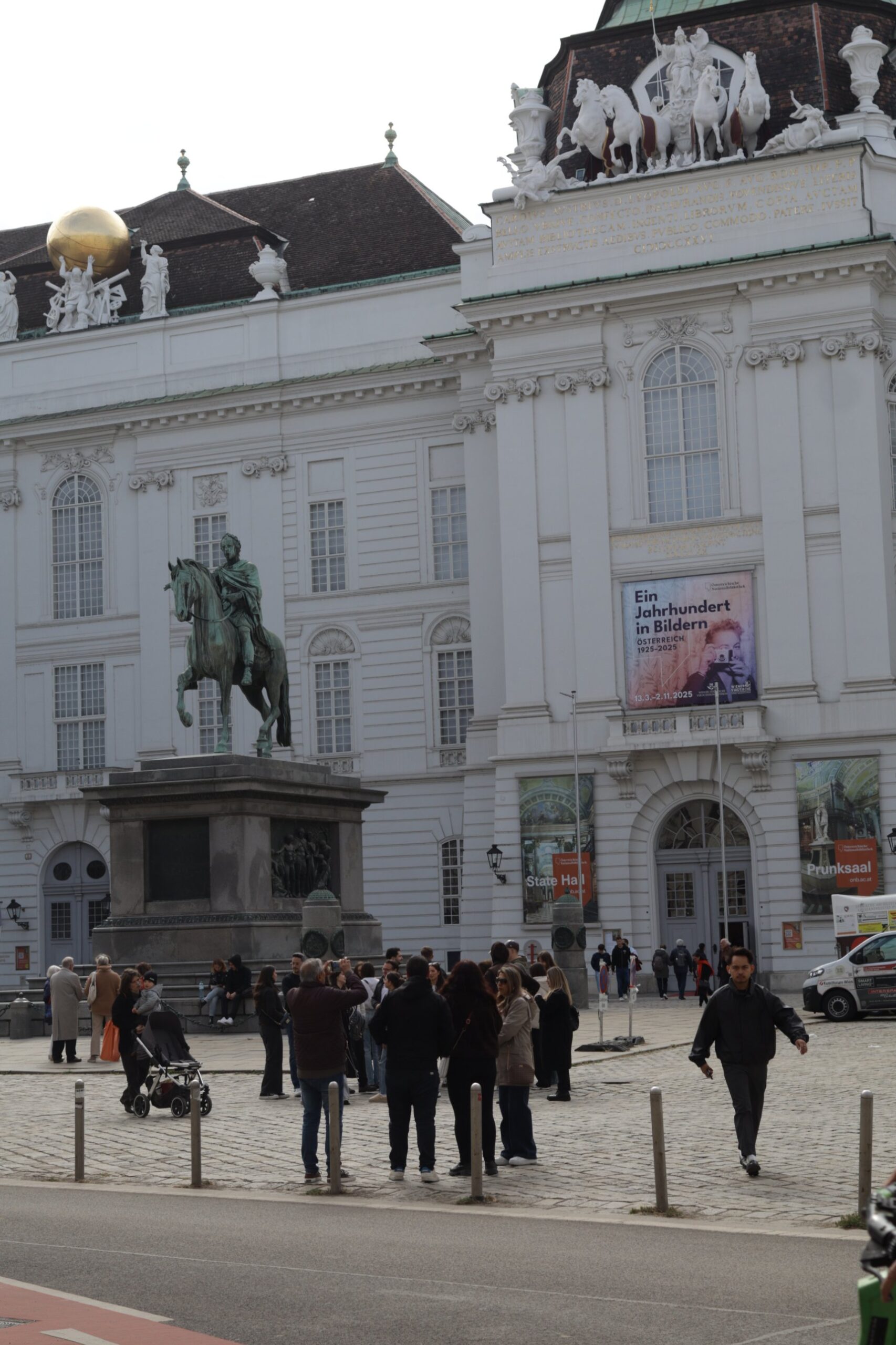
Photo: Virtual Travel Guide
Minerva wins
The group on top of the central pavilion shows Pallas Athene, the Roman Minerva, goddess of wisdom, rising in a quadriga, a chariot pulled by four horses. Below her are two figures she is throwing down: Envy and Ignorance. Nobody can say for sure which of the two is which.
The sculptor was Lorenzo Mattielli, an Italian who worked for the Viennese court and whose workshop did the sculpture for the library in 1726.
Heaven on the left, earth on the right
On the two side wings stand two gilded globes, and they're a pair.
On the left, as you face the building, Atlas carries the celestial globe, the sphere of the stars, with figures of Astronomy and Astrology beside him. On the right, the globe is the earth. It's held by Gaia, the earth goddess, not by a second Atlas, with Geography and Geometry helping her. Around both groups are scientific instruments.
Put the three groups together and the message is plain. A library holds the knowledge of the sky and the knowledge of the world, and wisdom drives out ignorance. The programme for it was devised by Conrad Adolph von Albrecht, the court scholar who also wrote the programme for Daniel Gran's great ceiling fresco inside.
What the inscription says
Under Minerva's chariot runs a long Latin inscription in gilded letters. In full it reads:
CAROLVS AVSTRIVS D. LEOPOLDI AVG. F. AVG. ROM. IMP. P.P. BELLO VBIQVE CONFECTO INSTAVRANDIS FOVENDISQVE LITERIS AVITAM BIBLIOTHECAM INGENTI LIBRORVM COPIA AVCTAM AMPLIS EXSTRVCTIS AEDIBVS PVBLICO COMMODO PATERE IVSSIT 1726
Roughly: Charles of Austria, son of the deified Leopold, Roman Emperor, Father of the Fatherland, having ended war everywhere, to restore and foster learning, ordered the library of his ancestors, enlarged with a vast number of books, to be opened for public use in the spacious buildings he had built. 1726.
Two things stand out. "Bello ubique confecto", war ended everywhere, is the kind of thing emperors liked to carve rather than the kind of thing that was true for long. And "publico commodo", for public use: Charles VI's court library was meant from the start to be open to scholars, not just to the court.
A second, shorter inscription lower down records a repair. In 1769 Joseph II and his mother Maria Theresa had the foundations and vaults underpinned. The building had been settling, and by 1740 there were already cracks in the dome.
Building and sculpture
The library was designed by Johann Bernhard Fischer von Erlach, who died in 1723, and built from 1723 to 1726 by his son Joseph Emanuel. The interior, with Gran's frescoes, the Coronelli globes and the statue of Charles VI as Hercules of the Muses, took a few more years. In the 1770s Nikolaus Pacassi gave the wings round the square new fronts, so that Josefsplatz reads as one composition.
Seeing it
Stand at the far side of the square, behind Joseph II's statue, to see the whole roofline at once. A long lens helps with the inscription. Then go inside: our State Hall guide covers tickets and what to look for.